Integration Challenges in the Multi-Model Era
As artificial intelligence continues its rapid evolution, the market now features a broad range of large language models and generative AI services from a variety of providers. These models each have their strengths—from text generation to advanced reasoning—but this diversity also creates new challenges for developers.
Each platform comes with its own API specifications, authentication methods, and billing models. Consequently, developers often need to manage multiple sets of credentials and interface logic during deployment. This increases system complexity and steadily drives up both development and maintenance costs.
Unified Interface: Lowering the Barriers to Development
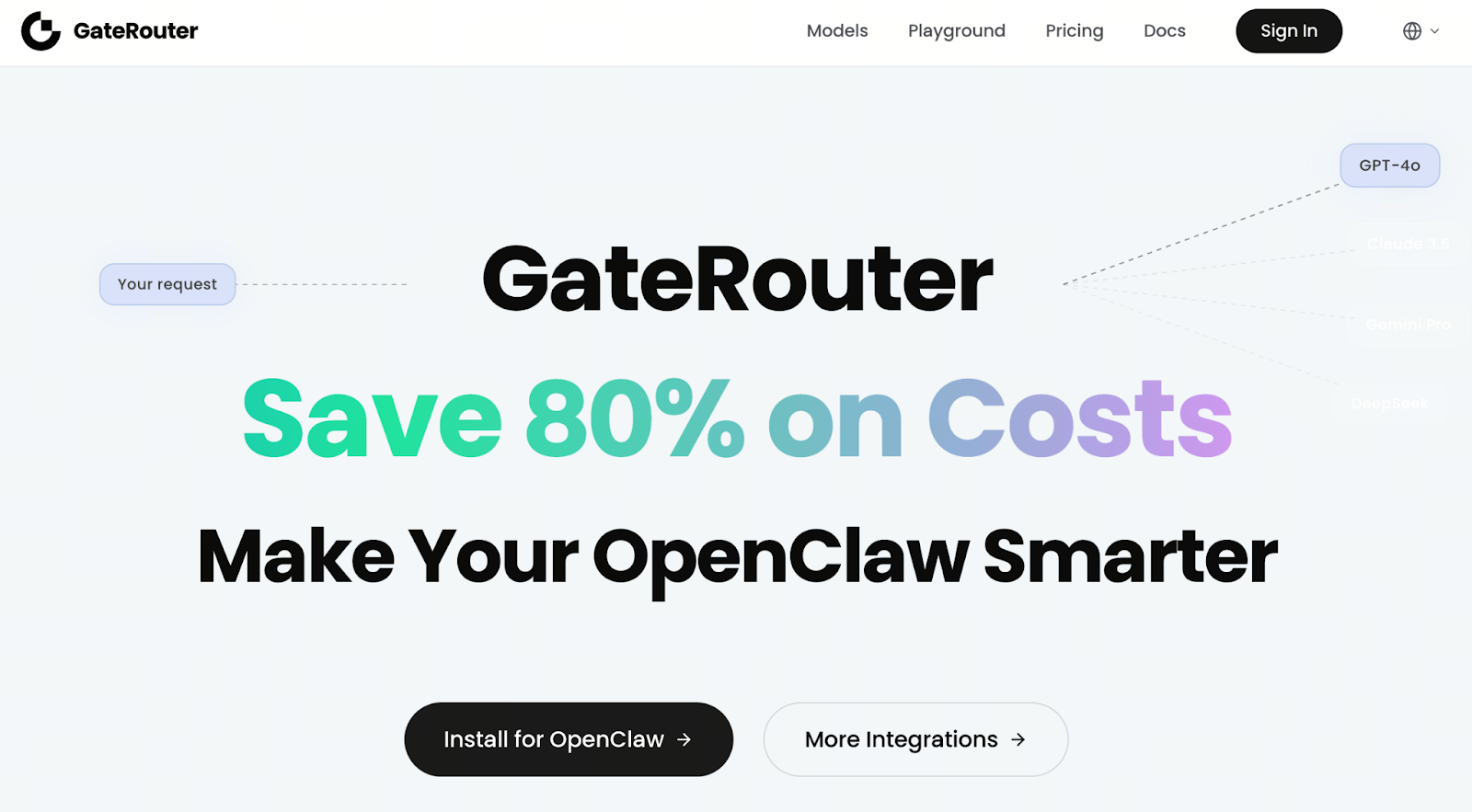
To resolve these challenges, GateRouter provides a streamlined integration approach. Through a single API, developers can connect to multiple leading AI model providers without repeatedly switching between different services.
The core advantage of this design is its ability to abstract away underlying differences, allowing developers to focus on building their applications rather than wrestling with integration issues. Whether the goal is to create chatbots, AI agents, or data analysis tools, teams can deploy solutions quickly with lower technical overhead.
Learn more about GateRouter: https://www.gaterouter.ai/
Selecting the optimal model in a multi-model environment is a continual optimization challenge. GateRouter automates this process with intelligent routing.
The system automatically allocates the most appropriate model based on task complexity and requirements. For straightforward text generation, it prioritizes lower-cost models. For tasks demanding high-precision reasoning, it switches to more powerful options. This dynamic allocation not only enhances overall output quality but also reduces resource waste, enabling developers to optimize costs without compromising results.
Rapid Deployment and Visual Management
Beyond optimizing model selection, GateRouter greatly simplifies the development experience. With an ultra-simple onboarding process, developers can integrate and test models in a short timeframe, significantly reducing development cycles. The platform also offers a comprehensive management dashboard, giving users full visibility into API activity—including request logs, usage statistics, and cost analysis. These tools empower teams to continually refine their strategies for greater operational efficiency.
The built-in testing environment (Playground) also enables developers to intuitively compare outputs and cost differences across models, providing actionable data for product optimization.
Data Security and Privacy Mechanisms
As AI applications become more deeply embedded in enterprise environments, data security has become a critical concern. GateRouter incorporates multiple safeguards to protect user data.
By default, the platform does not store conversation content and uses encrypted transmission to secure data in transit. An optional logging feature allows developers to balance debugging needs with privacy requirements. This approach is particularly well-suited for enterprise applications with high data sensitivity, such as fintech or data analytics services.
Extending to Diverse Application Scenarios
GateRouter is more than just a developer tool—it serves as foundational infrastructure for a wide range of use cases. For AI developers, it streamlines model integration. For enterprise users, it offers a stable and scalable API architecture. In the Web3 space, support for crypto payments makes decentralized application development even more flexible. Especially in scenarios like AI agents, automated trading, and on-chain applications, this integration capability becomes a key competitive advantage.
Flexible Billing and Payment Options
GateRouter adopts a flexible business model. With usage-based billing, developers will be able to adjust their spending based on real needs rather than fixed costs. The platform also supports multiple payment methods—including crypto assets and traditional payment tools—making it easy for users from all backgrounds to get started. This design further lowers the barrier to AI adoption and enhances accessibility across the ecosystem.
The Next Step for AI and Digital Asset Integration
As AI and blockchain technologies increasingly converge, future applications will no longer be confined to a single domain. GateRouter, as a critical link between AI models and the digital asset ecosystem, has the potential to become part of next-generation infrastructure. By continuously expanding model resources and optimizing routing mechanisms, platforms like GateRouter will further drive AI adoption in finance, automation, and on-chain applications.
Conclusion
In an era of explosive AI model growth, true competitive advantage no longer comes solely from the models themselves, but from how efficiently these resources are leveraged. GateRouter redefines AI development through unified interfaces and intelligent routing. Whether by reducing integration costs, boosting development efficiency, or expanding application possibilities, this platform-driven approach brings new opportunities to the industry. As AI and the Web3 ecosystem continue to intersect, solutions like GateRouter will play an increasingly pivotal role in the future.







