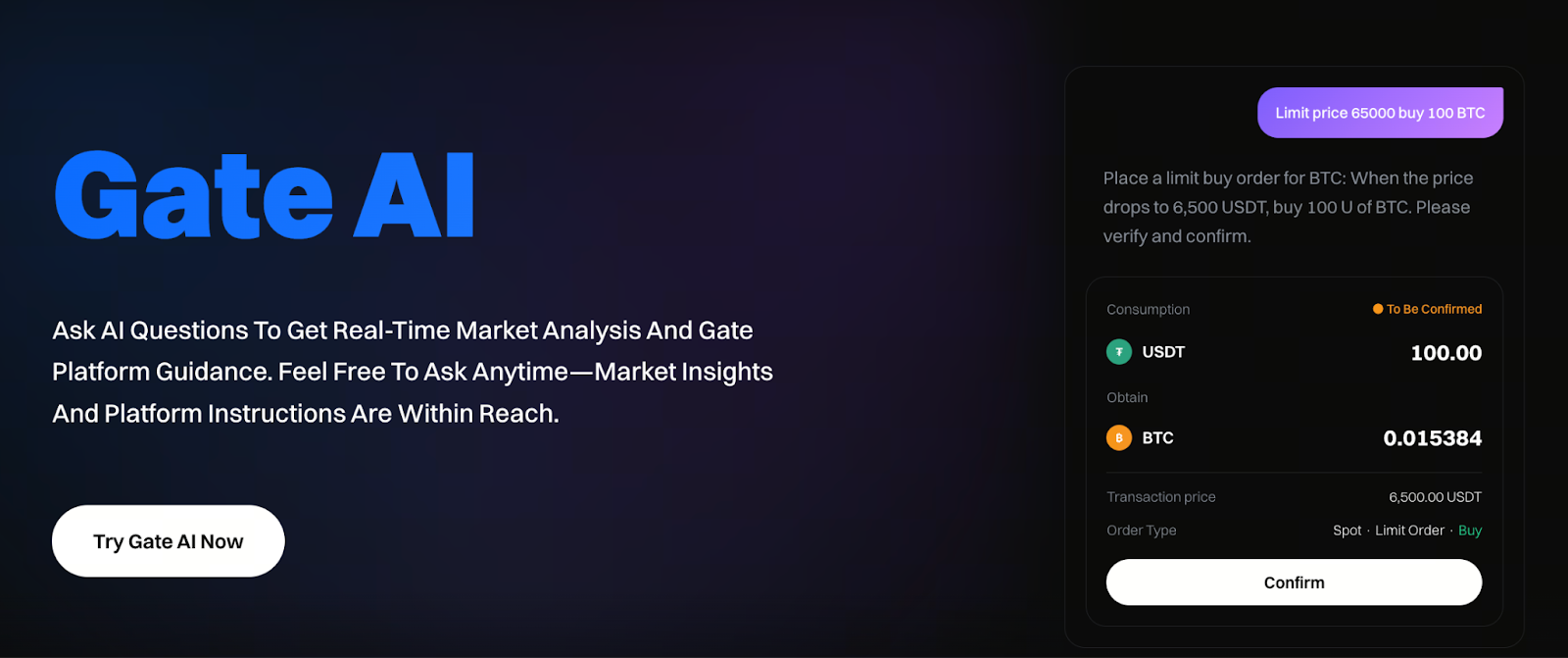
Gate AI: Redefining Crypto Marketplace Analysis in the Age of Information Overload

Last Updated 2026-04-03 14:33:53
Reading Time: 4m
In the rapidly evolving crypto market, information accumulates at an unprecedented pace. Traders must simultaneously track price movements, on-chain activity, group posts, and macro-level news—yet an abundance of information does not always lead to easier decision-making. Gate AI streamlines this complexity by integrating data and applying structured analysis to convert scattered signals into actionable market insights. Its conversational interface further reduces analytical barriers, empowering traders to grasp market dynamics with greater efficiency.

New Challenges from the Rapid Growth of Crypto Market Information

As the crypto industry evolves, market information sources have become more diverse. In addition to core price and filled amount data, on-chain trading activity, group discussions, and macroeconomic news can all influence market sentiment in a matter of moments.

More information does not always make trading easier. When data pours in from multiple channels at once, traders often spend considerable time sorting through it—and may suffer from information overload, making it difficult to react quickly. In highly volatile markets, the ability to filter out noise and identify key signals has become an essential skill for traders.

Gate AI Restructures Market Information

To address fragmented data, Gate AI is designed not just to provide more information but to integrate multiple sources into a clear analytical framework.

By systematically organizing data, users can quickly grasp the logic behind market moves. For example:

  • Are price swings linked to specific events or news?
  • Is capital concentrating in certain zones?
  • What might be causing unusual moves in individual assets?

By connecting these data points, market analysis becomes more than just tracking numbers—it enables a deeper understanding of the market as a whole.

Conversational Analysis for Intuitive Data Queries

To lower the barrier to entry, Gate AI turns complex data queries into simple, conversational interactions. Users just ask questions, and the system aggregates relevant data to deliver organized analysis.

For example, users might ask:

  • What’s driving recent volatility in a specific crypto asset?
  • Which sectors are attracting the most market attention?
  • Are there signs of abnormal trading or concentrated buying and selling?

Gate AI synthesizes data from multiple sources, making analysis more accessible and improving information efficiency.

From Price Movements to Market Context

Focusing only on price trends rarely provides a complete market picture. Gate AI analyzes market dynamics from multiple angles, helping traders build a more comprehensive perspective.

Key aspects the system may cover include:

  1. Capital flow direction

Tracking how funds shift between assets and zones.

  1. Market sentiment changes

Assessing shifts in investor sentiment through group and market discussions.

  1. Industry and project developments

Monitoring news about specific projects or industries and their potential market impact.

Multi-dimensional analysis enables traders to identify trends more clearly and make better-informed decisions.

Prioritizing Information Quality Over Speed

In financial markets, inaccurate or unverified information can lead to poor decisions, making accuracy essential. Gate AI takes a cautious approach to data processing. When data is insufficient or unconfirmed, the system clearly indicates uncertainty rather than making speculative claims. While this may reduce immediacy, it significantly boosts reliability, giving traders greater confidence in their analysis.

Integrating Analysis Tools Directly into the Trading Process

Traditional market analysis often requires switching between platforms—pricing sites, news portals, or data tools—which increases operational time and can hinder decision-making.

Gate AI integrates analytics directly into the trading environment, allowing users to query and analyze data while tracking market trends. This approach offers several advantages:

  • Reduces the time and friction of switching platforms
  • Lets users apply analytical results instantly to trading decisions
  • Improves overall trading efficiency

By merging information analysis with trading operations, market analysis becomes much more seamless.

The Evolving Role of AI in Trading

As AI technology advances, its role in trading continues to expand. Future analytical systems may incorporate even more data dimensions, such as:

  • Real-time market risk monitoring
  • Cross-referencing multi-source data
  • Predicting group sentiment and market trends

As information density grows, AI will become a critical tool for traders to filter out noise and highlight the signals that matter most.

Conclusion

In today’s crypto markets, accessing information is easy—the real challenge is organizing and understanding it quickly. Gate AI turns fragmented market signals into actionable insights by integrating multi-source data, building structured analytical frameworks, and providing conversational interfaces.

As markets and information density grow, the ability to efficiently process and interpret data will be a major edge for traders. Tools like Gate AI, which blend analysis and trading environments, are set to play an increasingly vital role in the market’s future.

Disclaimer
* The information is not intended to be and does not constitute financial advice or any other recommendation of any sort offered or endorsed by Gate.
* This article may not be reproduced, transmitted or copied without referencing Gate. Contravention is an infringement of Copyright Act and may be subject to legal action.

Related Articles

AI-Native Settlement Layers: How United Stables Is Building the Next Financial Rail
Beginner

AI-Native Settlement Layers: How United Stables Is Building the Next Financial Rail

Stablecoins were originally designed as dollar substitutes within exchanges, primarily used for asset pricing and trade settlement. As on-chain financial ecosystems have matured, their role has expanded beyond simple payments to include collateral assets, cross-chain liquidity mediums, and unified settlement units. In particular, as AI systems and automated agents begin to participate directly in economic activity, demand has risen sharply for programmable value units capable of instant settlement. This shift is pushing stablecoins toward the role of foundational financial infrastructure.
2026-03-25 03:16:17
The ve(3,3) Flywheel Explained: How AERO Tokenomics Powers Aerodrome’s DeFi Economy
Beginner

The ve(3,3) Flywheel Explained: How AERO Tokenomics Powers Aerodrome’s DeFi Economy

In the competition for DeFi liquidity, high-inflation mining alone is no longer enough to build lasting advantages. Aerodrome applies the ve(3,3) economic model to redesign token emissions, voting mechanisms, and revenue distribution, creating a liquidity flywheel centered on governance and cash flow. This article examines AERO tokenomics, the veAERO locking mechanism, and protocol revenue models to explain how Aerodrome builds a sustainable DeFi economic system.
2026-03-25 06:41:58
Aerodrome Tokenomics: How ve(3,3) Powers Base's Most Profitable DEX
Beginner

Aerodrome Tokenomics: How ve(3,3) Powers Base's Most Profitable DEX

AERO is the native token of Aerodrome Finance, a core decentralized exchange and liquidity protocol in the Base ecosystem. It is primarily used for liquidity incentives and ecosystem operations. veAERO is a governance NFT that users receive by locking AERO, representing both voting power and the right to share protocol revenue. Through a dual track structure of AERO as a utility token and veAERO as a governance credential, Aerodrome separates liquidity usage value from long term governance power, allowing participants to act as liquidity providers, governance decision makers, and revenue sharers within the same system.
2026-03-25 06:40:31
How Does PAXG Work? In-Depth Overview of the Physical Gold Tokenization Mechanism
Beginner

How Does PAXG Work? In-Depth Overview of the Physical Gold Tokenization Mechanism

PAXG (Pax Gold) is a tokenized asset backed by physical gold, issued by the fintech company Paxos and traded on the Ethereum blockchain as an ERC-20 token. The core concept is to tokenize physical gold on-chain, with each PAXG token representing ownership of a certain amount of gold. This structure enables investors to hold and trade gold in the form of a digital asset.
2026-03-24 19:12:51
How is the price of PAXG determined? Pegging mechanism, trading depth, and influencing factors
Beginner

How is the price of PAXG determined? Pegging mechanism, trading depth, and influencing factors

PAXG (Pax Gold) is a tokenized asset backed by physical gold reserves, launched by fintech firm Paxos and issued as an ERC-20 token on the Ethereum blockchain. The core concept is to digitally represent real-world gold assets, allowing investors to hold and trade gold via the blockchain network. Because each PAXG token corresponds to a specific quantity of physical gold, its price is theoretically expected to closely track the global gold market.
2026-03-24 19:11:40
DePIN Identity Network and Real World Applications: How Humanity Protocol Brings on-chain Identity Into the Physical World
Beginner

DePIN Identity Network and Real World Applications: How Humanity Protocol Brings on-chain Identity Into the Physical World

Most Web3 identity systems remain confined to on-chain environments and struggle to achieve meaningful adoption in real world settings. Through a DePIN architecture and physical verification hardware, Humanity Protocol aims to bring decentralized identity into access control systems, hospitality, public services, and offline events, allowing on-chain identity to function not just as a digital credential, but as foundational infrastructure for real world access.
2026-03-25 07:40:53





