This article provides a detailed investment comparison between two cryptocurrencies, Akedo (AKE) and Loopring (LRC), focusing on their price history, technological advancements, and market positioning. It addresses investor concerns about which token is a better buy by examining project risks, regulatory landscapes, and long-term investment strategies. Suitable for both novice and experienced investors, the article highlights each token's unique advantages, including AKE's AI-driven game development innovation and LRC's established DeFi infrastructure. Readers can explore comprehensive insights into future market dynamics and investment strategies to make informed decisions.
Introduction: Investment Comparison of AKE vs LRC
In the cryptocurrency market, the comparison between Akedo vs Loopring has been an unavoidable topic for investors. The two not only show significant differences in market cap ranking, application scenarios, and price performance but also represent different positioning in crypto assets.
Akedo (AKE): Since its launch, it has gained market recognition for its AI-powered game and content creation platform.
Loopring (LRC): Introduced in 2017, it has been hailed as a decentralized exchange protocol, aiming to provide zero-risk token exchange models.
This article will comprehensively analyze the investment value comparison between AKE vs LRC, focusing on historical price trends, supply mechanisms, institutional adoption, technological ecosystems, and future predictions, attempting to answer the question investors care about most:
"Which is the better buy right now?"
I. Price History Comparison and Current Market Status
AKE and LRC Historical Price Trends
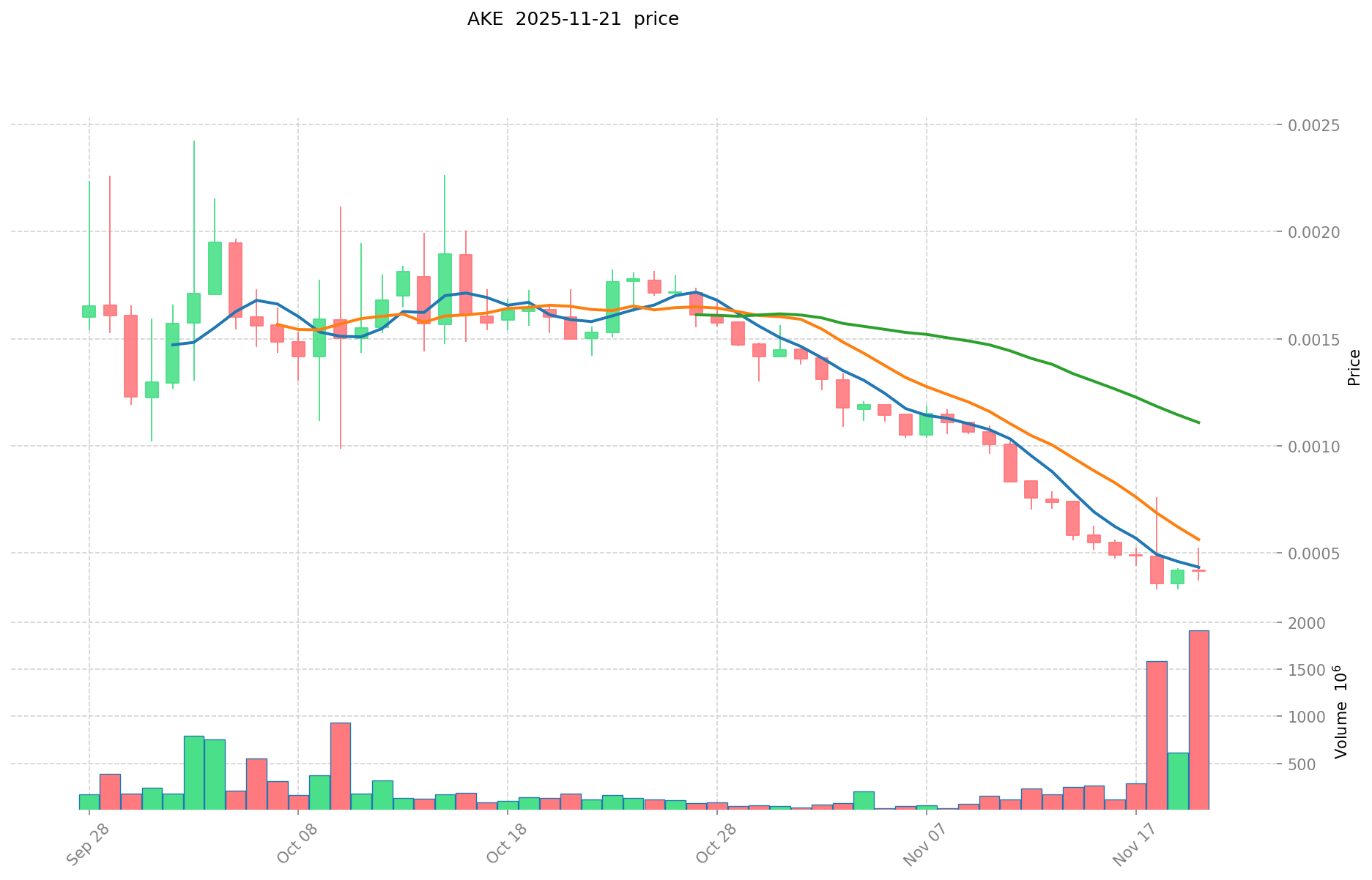
- 2025: AKE reached its all-time high of $0.0024262 on October 3, 2025.
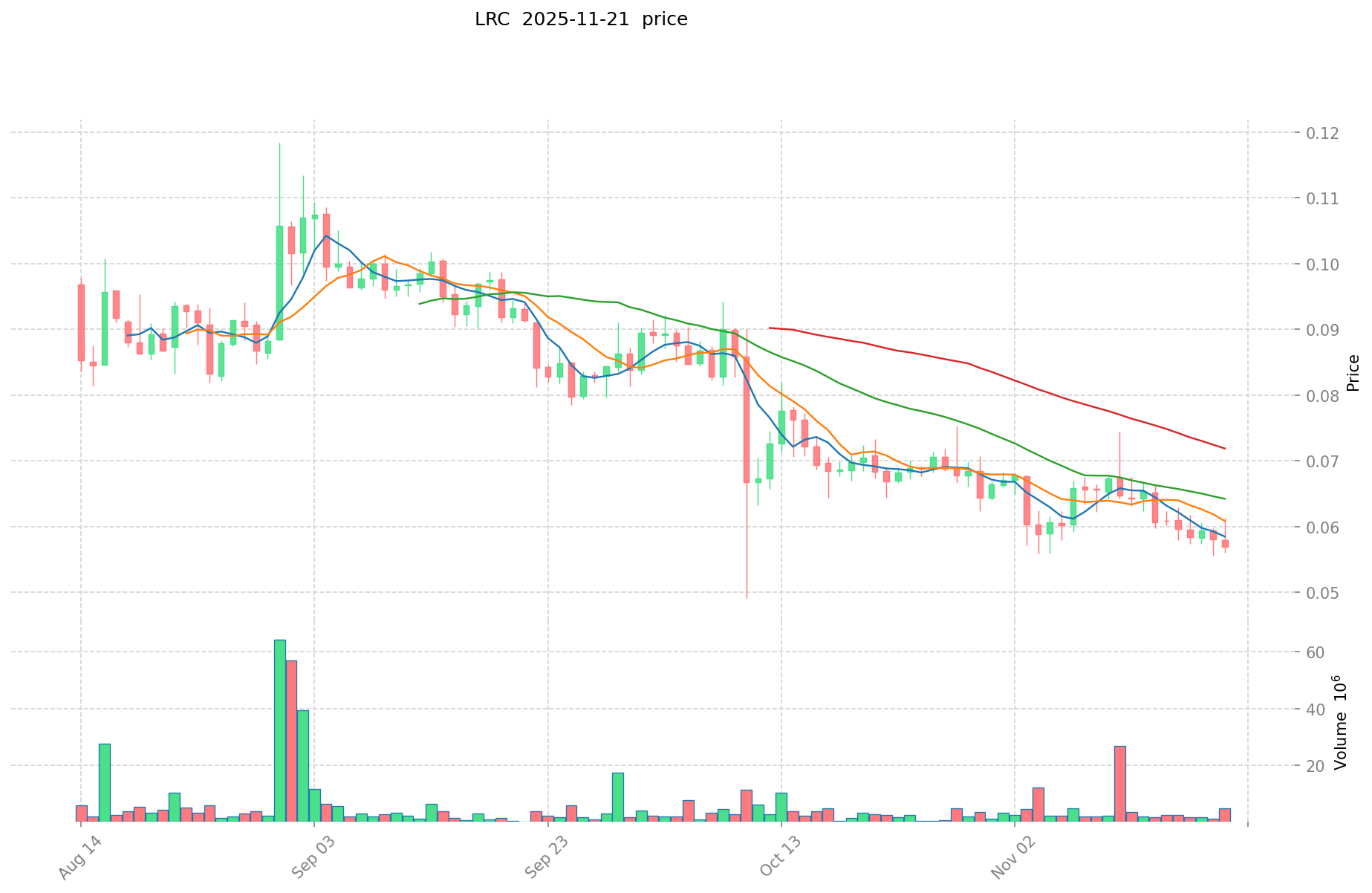
- 2025: LRC experienced a significant decline, with its price dropping by 68.99% over the past year.
- Comparative analysis: In the recent market cycle, AKE dropped from its all-time high of $0.0024262 to a low of $0.0003286, while LRC has fallen from its all-time high of $3.75 to its current price of $0.05363.
Current Market Situation (2025-11-21)
- AKE current price: $0.000379
- LRC current price: $0.05363
- 24-hour trading volume: AKE $436,160.06 vs LRC $288,044.94
- Market Sentiment Index (Fear & Greed Index): 14 (Extreme Fear)
Click to view real-time prices:
- View AKE current price Market Price
- View LRC current price Market Price
II. Project Overview and Technology Comparison
AKE (Akedo)
- Project description: AKEDO is a vibe coding Game & Content Creation Engine and Launchpad that leverages AI agents to improve development efficiency 100x over traditional LLM solutions.
- Key features:
- AI-powered game and content creation engine
- Launchpad for game collections
- One-click token launch for collections
- Technology highlights: Utilizes AI agents to significantly enhance development efficiency
LRC (Loopring)
- Project description: Loopring is an open multi-token transaction protocol based on ERC20 and smart contracts, enabling decentralized exchange applications without asset custody and capital freezing.
- Key features:
- Decentralized token exchange model
- Off-chain matching and on-chain settlement
- Low transaction costs for LRC holders
- Technology highlights: Zero-risk token exchange model, competitive order matching across multiple exchanges
Comparative Analysis
- Market focus: AKE targets the gaming and content creation sector, while LRC focuses on decentralized exchange infrastructure.
- Technological approach: AKE emphasizes AI-driven efficiency, whereas LRC prioritizes decentralized trading mechanisms.
- User benefits: AKE offers streamlined game development and tokenization, while LRC provides cost-effective trading solutions.
AKE (Akedo)
- Market cap: $8,641,200
- Circulating supply: 22,800,000,000 AKE
- 24h price change: -11.44%
- 7d price change: -34.73%
- 30d price change: -74.56%
LRC (Loopring)
- Market cap: $66,822,522.48
- Circulating supply: 1,245,991,468.94 LRC
- 24h price change: -8.68%
- 7d price change: -14.68%
- 30d price change: -20.77%
Comparative Analysis
- Market capitalization: LRC's market cap is significantly larger than AKE's, indicating a more established position in the market.
- Price volatility: Both tokens have shown negative price movements across all timeframes, with AKE experiencing more severe declines.
- Supply dynamics: AKE has a larger circulating supply compared to LRC, which may impact price movements differently.
IV. Recent Developments and Future Outlook
AKE (Akedo)
- Recent milestones: No specific recent developments mentioned in the provided data.
- Future prospects: The project's focus on AI-driven game development and content creation may position it well in the growing gaming and metaverse sectors.
LRC (Loopring)
- Recent milestones: No specific recent developments mentioned in the provided data.
- Future prospects: As a well-established project in the decentralized exchange space, LRC may benefit from the ongoing growth of DeFi and increased demand for decentralized trading solutions.
Industry Trends
- The gaming and metaverse sectors continue to attract attention and investment.
- Decentralized finance (DeFi) remains a key focus in the cryptocurrency ecosystem.
- AI integration in blockchain projects is gaining traction, potentially benefiting projects like AKE.
V. Risk Analysis
Market Risks
- Both AKE and LRC are experiencing significant price volatility, with substantial declines across various timeframes.
- The current extreme fear market sentiment (Fear & Greed Index: 14) indicates a challenging overall market environment.
Project-Specific Risks
- AKE:
- Relatively new project with a smaller market cap, potentially leading to higher volatility.
- Dependence on the success and adoption of its AI-driven game development platform.
- LRC:
- Increased competition in the decentralized exchange sector.
- Regulatory risks associated with decentralized finance platforms.
Regulatory and Compliance Considerations
- Both projects may face scrutiny as regulatory bodies worldwide continue to develop frameworks for cryptocurrency and DeFi platforms.
- The gaming-focused nature of AKE may subject it to additional regulations specific to the gaming industry.
VI. Conclusion
AKE and LRC represent different sectors within the cryptocurrency ecosystem, with AKE focusing on AI-driven game development and content creation, while LRC targets decentralized exchange infrastructure. Both projects are currently facing challenging market conditions, as evidenced by their recent price declines and the overall market sentiment.
AKE's innovative approach to game development using AI could position it well for future growth, particularly as the gaming and metaverse sectors continue to expand. However, its smaller market cap and recent volatility suggest higher risk.
LRC, with its more established position in the market and focus on decentralized trading, may offer more stability but still faces significant competition in the DeFi space. Its longer track record and larger market cap could be seen as advantages in terms of project maturity.
Investors should carefully consider the distinct value propositions, market positions, and risk profiles of both projects in the context of their investment strategies and risk tolerance.
II. Key Factors Affecting the Investment Value of AKE vs LRC
Supply Mechanisms Comparison (Tokenomics)
-
AKE: Fixed maximum supply of 5 billion tokens, with 56% already in circulation
-
LRC: Total supply of approximately 1.37 billion tokens, deflationary model with token burning through protocol fees
-
📌 Historical Pattern: Deflationary tokenomics like LRC's have historically provided stronger price support during market downturns, while fixed supply tokens like AKE benefit more directly from increased network adoption.
Institutional Adoption and Market Applications
- Institutional Holdings: LRC has attracted more institutional interest due to its established position in the Layer 2 scaling solution space
- Enterprise Adoption: LRC has stronger enterprise applications through its zkRollup technology for Ethereum scaling, while AKE is still building its enterprise use cases
- Regulatory Attitudes: Both tokens face similar regulatory scrutiny as utility tokens, though LRC's longer market presence provides more regulatory clarity
Technical Development and Ecosystem Building
- AKE Technical Upgrades: Working on implementing consensus mechanism improvements and expanding cross-chain capabilities
- LRC Technical Development: Continuous improvements to zkRollup technology, enhanced smart wallet features, and DEX infrastructure
- Ecosystem Comparison: LRC has a more developed DeFi ecosystem with its DEX protocol and payment solutions, while AKE is focusing on building its NFT and gaming infrastructure
Macroeconomic Factors and Market Cycles
- Performance in Inflationary Environments: LRC has demonstrated better resilience during inflationary periods due to its deflationary tokenomics
- Macroeconomic Monetary Policy: Both tokens show high correlation with risk assets, with interest rate hikes typically creating stronger headwinds for newer assets like AKE
- Geopolitical Factors: Increasing demand for decentralized finance solutions benefits both tokens, with LRC's Ethereum scaling solutions potentially offering more immediate utility
III. 2025-2030 Price Prediction: AKE vs LRC
Short-term Prediction (2025)
- AKE: Conservative $0.000199784 - $0.0003842 | Optimistic $0.0003842 - $0.000545564
- LRC: Conservative $0.0423835 - $0.05365 | Optimistic $0.05365 - $0.0649165
Mid-term Prediction (2027)
- AKE may enter a growth phase, with expected price range of $0.000390733321 - $0.0004907991715
- LRC may enter a bullish market, with expected price range of $0.0603266352 - $0.07477989155
- Key drivers: Institutional capital inflow, ETF, ecosystem development
Long-term Prediction (2030)
- AKE: Base scenario $0.000322034588501 - $0.000575061765181 | Optimistic scenario $0.000575061765181 - $0.000615316088744
- LRC: Base scenario $0.098080495117819 - $0.10324262643981 | Optimistic scenario $0.10324262643981 - $0.115631741612587
View detailed price predictions for AKE and LRC
Disclaimer: The above predictions are based on historical data and market analysis. Cryptocurrency markets are highly volatile and subject to rapid changes. These projections should not be considered as financial advice. Always conduct your own research before making investment decisions.
AKE:
| 年份 |
预测最高价 |
预测平均价格 |
预测最低价 |
涨跌幅 |
| 2025 |
0.000545564 |
0.0003842 |
0.000199784 |
1 |
| 2026 |
0.0004881261 |
0.000464882 |
0.00044628672 |
22 |
| 2027 |
0.0004907991715 |
0.00047650405 |
0.000390733321 |
25 |
| 2028 |
0.000507834191287 |
0.00048365161075 |
0.000459469030212 |
27 |
| 2029 |
0.000654380629344 |
0.000495742901018 |
0.000475913184978 |
30 |
| 2030 |
0.000615316088744 |
0.000575061765181 |
0.000322034588501 |
51 |
LRC:
| 年份 |
预测最高价 |
预测平均价格 |
预测最低价 |
涨跌幅 |
| 2025 |
0.0649165 |
0.05365 |
0.0423835 |
0 |
| 2026 |
0.06639724 |
0.05928325 |
0.0385341125 |
10 |
| 2027 |
0.07477989155 |
0.062840245 |
0.0603266352 |
17 |
| 2028 |
0.101838901047 |
0.068810068275 |
0.04059794028225 |
28 |
| 2029 |
0.12116076821862 |
0.085324484661 |
0.05204793564321 |
59 |
| 2030 |
0.115631741612587 |
0.10324262643981 |
0.098080495117819 |
92 |
IV. Investment Strategy Comparison: AKE vs LRC
Long-term vs Short-term Investment Strategies
- AKE: Suitable for investors focusing on AI-powered gaming and content creation potential
- LRC: Suitable for investors interested in decentralized exchange infrastructure and DeFi growth
Risk Management and Asset Allocation
- Conservative investors: AKE: 20% vs LRC: 80%
- Aggressive investors: AKE: 40% vs LRC: 60%
- Hedging tools: Stablecoin allocation, options, cross-token portfolios
V. Potential Risk Comparison
Market Risks
- AKE: Higher volatility due to smaller market cap and newer project status
- LRC: Exposure to broader DeFi market fluctuations and competition
Technical Risks
- AKE: Scalability, network stability in gaming applications
- LRC: Smart contract vulnerabilities, zkRollup technology risks
Regulatory Risks
- Global regulatory policies may impact both tokens differently, with LRC potentially facing more scrutiny due to its DeFi focus
VI. Conclusion: Which Is the Better Buy?
📌 Investment Value Summary:
- AKE advantages: Innovative AI-driven game development, potential growth in gaming and metaverse sectors
- LRC advantages: Established position in DeFi, zkRollup technology for Ethereum scaling, larger market cap
✅ Investment Advice:
- Novice investors: Consider a smaller allocation to LRC due to its more established market position
- Experienced investors: Explore a balanced portfolio with both AKE and LRC to capture potential growth in different sectors
- Institutional investors: Focus on LRC for its DeFi infrastructure play, while monitoring AKE's development in the gaming sector
⚠️ Risk Warning: The cryptocurrency market is highly volatile, and this article does not constitute investment advice.
None
VII. FAQ
Q1: What are the main differences between AKE and LRC in terms of their focus and technology?
A: AKE focuses on AI-powered game and content creation, utilizing AI agents to enhance development efficiency. LRC, on the other hand, is a decentralized exchange protocol that aims to provide zero-risk token exchange models using off-chain matching and on-chain settlement.
Q2: How do the market capitalizations of AKE and LRC compare?
A: LRC has a significantly larger market capitalization of $66,822,522.48 compared to AKE's $8,641,200, indicating a more established position in the market for LRC.
Q3: What are the key risks associated with investing in AKE and LRC?
A: For AKE, key risks include its relatively new project status, smaller market cap leading to higher volatility, and dependence on the success of its AI-driven platform. LRC faces risks from increased competition in the decentralized exchange sector and potential regulatory scrutiny in the DeFi space.
Q4: How do the tokenomics of AKE and LRC differ?
A: AKE has a fixed maximum supply of 5 billion tokens, with 56% already in circulation. LRC employs a deflationary model with a total supply of approximately 1.37 billion tokens and implements token burning through protocol fees.
Q5: Which token might be more suitable for different types of investors?
A: Conservative investors might consider allocating 20% to AKE and 80% to LRC, while aggressive investors could opt for 40% AKE and 60% LRC. LRC may be more suitable for novice investors due to its more established market position, while experienced investors might explore a balanced portfolio of both tokens.
Q6: What are the long-term price predictions for AKE and LRC by 2030?
A: By 2030, AKE's base scenario price range is predicted to be $0.000322034588501 - $0.000575061765181, with an optimistic scenario of $0.000575061765181 - $0.000615316088744. For LRC, the base scenario range is $0.098080495117819 - $0.10324262643981, with an optimistic scenario of $0.10324262643981 - $0.115631741612587.
Q7: How do macroeconomic factors affect AKE and LRC differently?
A: LRC has demonstrated better resilience during inflationary periods due to its deflationary tokenomics. Both tokens show high correlation with risk assets, but interest rate hikes typically create stronger headwinds for newer assets like AKE. Increasing demand for decentralized finance solutions benefits both tokens, with LRC's Ethereum scaling solutions potentially offering more immediate utility.
* The information is not intended to be and does not constitute financial advice or any other recommendation of any sort offered or endorsed by Gate.












