When using Layer2 networks, users typically care about why transactions are faster, why fees are lower, and how those transactions get confirmed. In DeFi and high-frequency interaction scenarios, understanding the full execution path is crucial for evaluating the system’s reliability and risk.
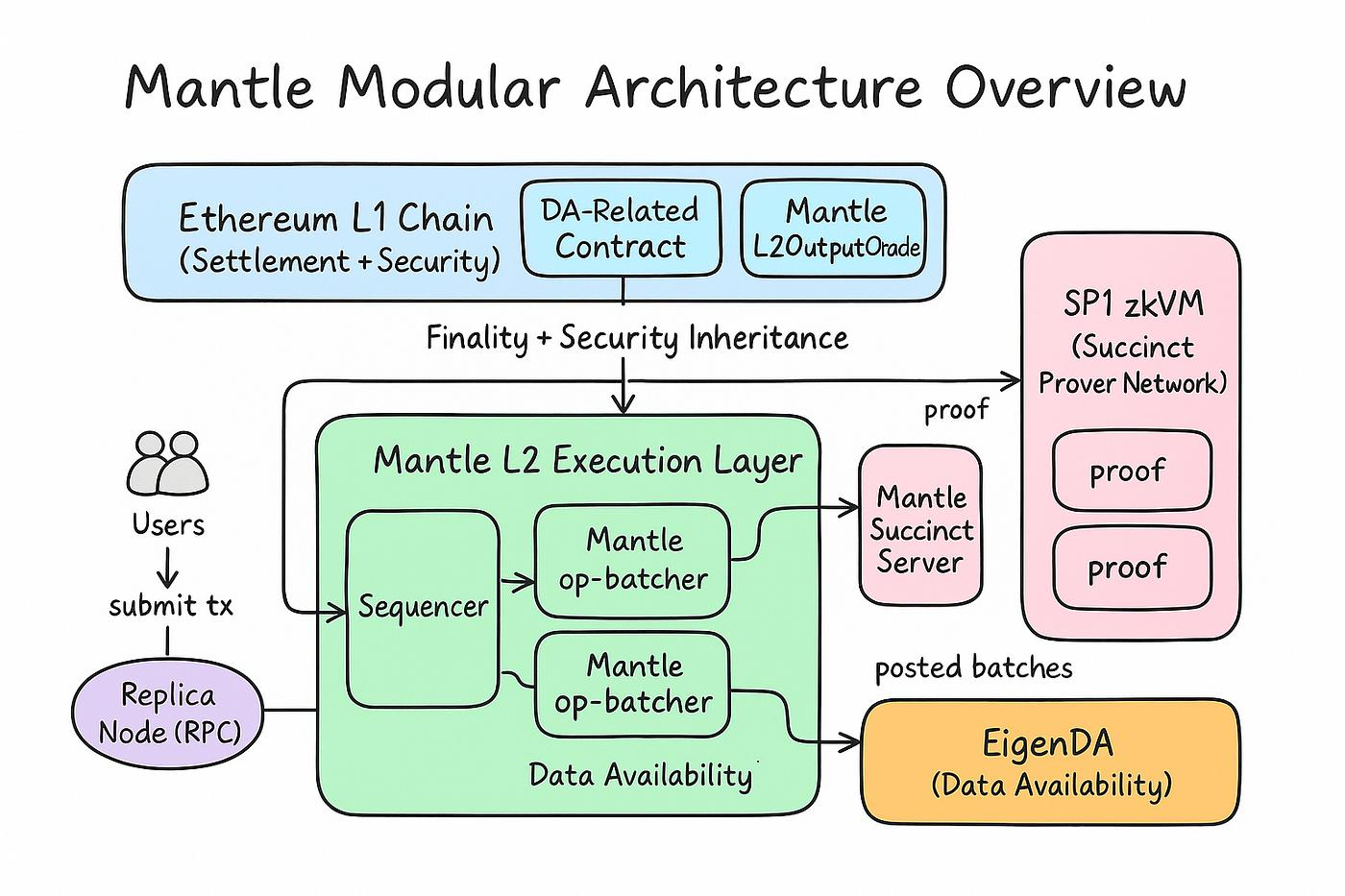
This process generally covers three core stages: transaction submission, sequencing and execution, and settlement confirmation. Together, these modules form the operational logic of Mantle.
How Users Access the Mantle Network
Accessing Mantle essentially means switching from the Ethereum mainnet to a Layer2 environment.
Technically, users move assets from Ethereum to Mantle via a wallet or cross-chain bridge. This process locks assets on Ethereum and issues corresponding balances on Layer2, enabling users to transact on Mantle.
The entry point consists of three main components: the wallet interface, the bridge, and network nodes. The wallet sends requests, the bridge maps assets, and the nodes receive transactions.
This design allows users to access Layer2 without changing their habits while maintaining consistency with their Ethereum assets.
How Transactions Are Submitted on Mantle
Submitting a transaction starts the entire process.
When a user initiates a transaction, it’s sent to Mantle network nodes, which receive and cache the transaction data. At this phase, transactions aren’t executed yet—they wait for the sequencer to process them.
Transaction data includes call details, signatures, and fee parameters that define later execution logic. Mantle typically uses Ethereum-compatible interfaces so developers can reuse existing tools.
This stage converts user actions into executable data structures, laying the groundwork for further processing.
How the Sequencer Orders and Batches Transactions
The sequencer is the core of Mantle’s execution process.
It selects transactions from the pending pool, orders them based on rules such as fee, time, or system policy, and batches them for processing. The sequencer acts as a “temporary consensus layer,” determining the final order before settlement. This centralized sequencing greatly boosts efficiency and reduces latency.
By centralizing sequencing logic, Mantle achieves higher throughput, while the final results are validated by Ethereum.
How the Execution Layer Handles State Updates
The execution layer turns transactions into state changes.
Batched transactions run in Mantle’s execution environment, updating account balances, smart contract states, and related data. The execution produces a new state root for later verification.
Mantle’s execution layer is EVM-compatible, so developers can deploy existing smart contracts directly. State updates follow deterministic rules so all nodes can reproduce the results.
This stage translates user actions into on-chain state changes—the heart of value flow in the system.
How Data Is Sent to the Data Availability Layer
The data availability layer determines how transaction data is stored.
After execution, transaction data is compressed and sent to the data availability layer for storage, rather than being written in full to Ethereum. This significantly lowers costs.
Decoupling the data layer from the execution layer lets the system optimize storage independently. Nodes can access this data for validation, ensuring transparency.
This approach reduces the mainnet’s load and keeps data accessible, making network operations more efficient.
How Ethereum Completes Final Settlement
Settlement determines transaction security.
Mantle submits state updates to the Ethereum mainnet for final confirmation. If there’s a dispute, the system’s verification mechanisms resolve it.
Ethereum serves as Mantle’s “final arbitration layer,” ensuring all state changes are correct. This structure lets Layer2 deliver high performance while inheriting mainnet security.
This stage anchors Layer2 execution outcomes to Ethereum, balancing security and efficiency.
Summary
Mantle merges high-performance execution with Ethereum-level security through a layered process—transaction submission, sequencing and execution, data storage, and mainnet settlement—making it a prime example of modular Layer2 architecture.
FAQ
Why Are Transactions on Mantle Faster Than Ethereum?
Transactions execute on Layer2 and are centrally processed by the sequencer, reducing confirmation times.
Does Mantle Require Ethereum to Operate?
Yes. Ethereum acts as the settlement layer and provides final security.
What Role Does the Sequencer Play in Mantle?
It sorts and batches transactions—it's the key component of the execution process.
What Is the Purpose of the Data Availability Layer?
It stores transaction data, reduces mainnet costs, and ensures data remains verifiable.
When Is a Mantle Transaction Final?
A transaction is final only after its state update is submitted to Ethereum and confirmed.