In recent years, AI technologies (led by large language models) have developed rapidly, driving exponential growth in the demand for computing power. Whether for model training or inference deployment, high-performance resources like GPUs are essential. Yet today, the majority of computing capacity remains in the hands of a few major cloud providers, resulting in high costs, resource scarcity, and steep barriers to entry.
At the same time, vast amounts of idle GPU resources around the world remain underutilized, providing a real-world foundation for the growth of decentralized computing networks. Render was originally positioned as a decentralized GPU rendering network, primarily serving the film industry and 3D content creators.
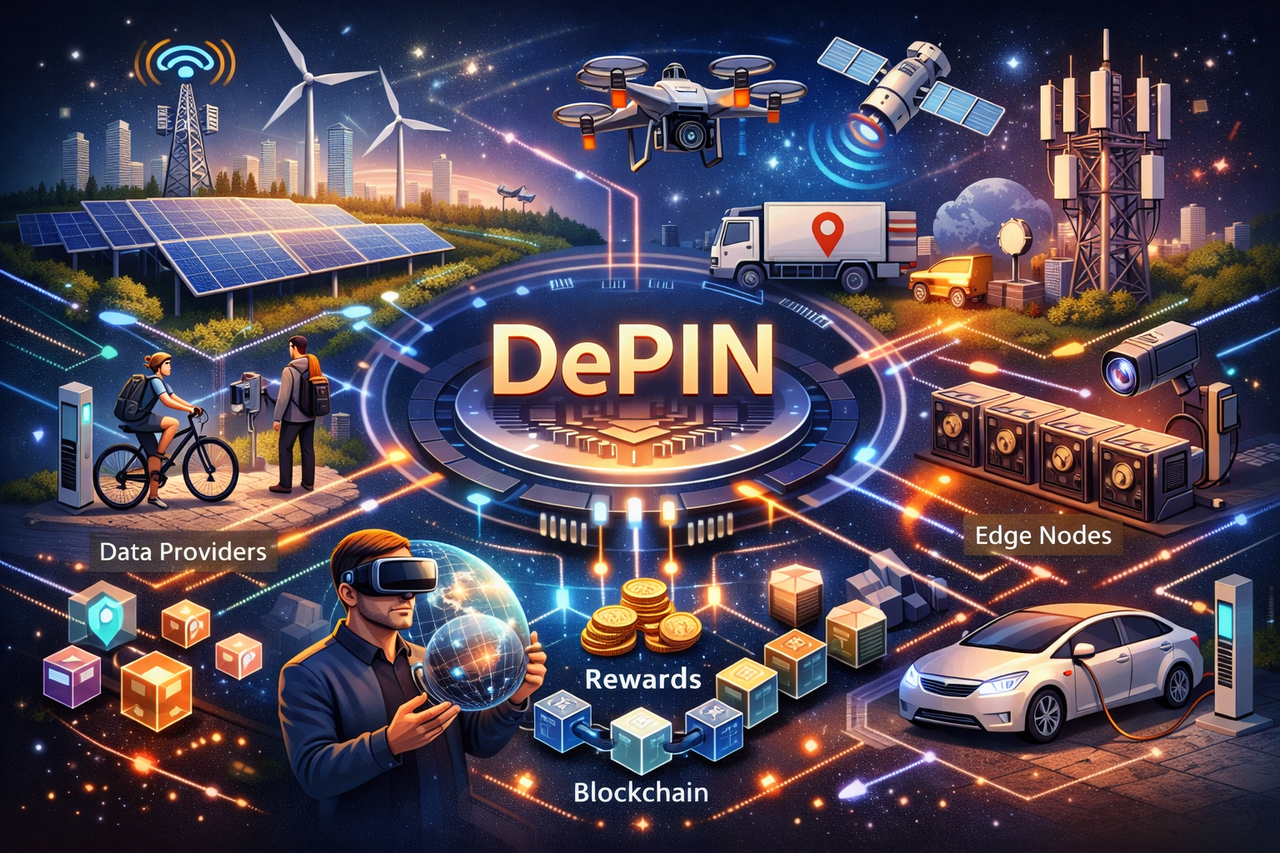
So as AI demand for GPUs continues to grow, Render is steadily expanding its scope, emerging as one of the key players in the DePIN computing power sector.
Why Does AI Need Decentralized Computing Power?
AI's demand for computing power is inherently peaky and uneven, making it difficult for traditional centralized cloud computing to meet these dynamic needs efficiently. On one hand, centralized cloud services are expensive, especially during periods of GPU scarcity. On the other hand, small and medium-sized teams often struggle to access stable computing resources.
Decentralized computing networks mobilize idle resources globally through market mechanisms, enabling a more flexible supply of computing power while lowering entry barriers. Their open architecture also helps reduce reliance on any single provider, improving system resilience against risk.
How Does Render Provide Computing Power Support for AI?
Render's core mechanism involves splitting computational tasks and distributing them to GPU nodes around the world for execution, while a verification mechanism ensures the accuracy of results. In AI scenarios, this architecture can support certain parallelizable tasks such as data processing, model inference, and graphics-related AI workloads.
In addition, Render has built an economic system centered on "compute trading" through the RENDER token. The token serves not only as a payment medium but also plays a central role in incentivizing nodes, balancing supply and demand, and capturing value.
Although Render was not purpose-built for AI, its GPU network is inherently capable of executing AI tasks — particularly in scenarios requiring large-scale parallel processing, where it can provide supplementary computing support.
Render in AI Training
When it comes to AI training, Render's applications are relatively limited, though it retains potential in specific scenarios. For example, certain distributed training tasks or data preprocessing pipelines can leverage the GPU nodes in the Render network for acceleration.
However, since AI training typically requires high bandwidth, low latency, and tightly synchronized environments across nodes (and Render is better suited to loosely coupled tasks), its advantages in large-scale model training are less pronounced compared to dedicated AI computing platforms.
Render in AI Inference
Compared to training, Render is a much better fit for AI inference scenarios. Inference tasks can typically be broken down into multiple independent requests and executed in parallel across different nodes, aligning closely with Render's task distribution mechanism.
For example, in use cases such as image generation, video processing, or real-time content generation, Render can provide additional computing power for AI inference, reducing latency and improving processing efficiency.
AI + Rendering Crossover Use Cases
Render's most promising direction in the AI space is actually the crossover between AI and rendering. Examples include:
-
Image and video generation in AI-generated content (AIGC)
-
Automated 3D model generation and optimization
-
Virtual humans and game asset generation
-
Digital twins and real-time rendering
In these scenarios, AI handles content generation while Render provides high-quality rendering capabilities. The two form a natural synergy, giving Render a unique edge within the Web3 content production ecosystem.
Render vs Traditional AI Cloud Computing
Compared to traditional cloud computing, Render presents a distinct profile in AI compute supply. Traditional cloud services offer stable, high-performance all-in-one solutions, but at higher prices and with centralized resources. Render, by contrast, delivers more flexible compute supply through its decentralized network — potentially at more competitive costs, though stability depends on node quality.
In terms of suitability, traditional cloud is better suited for core training tasks, while Render is more appropriate as supplementary compute — for inference workloads or non-critical computation tasks.
Render's Strengths and Limitations in the AI Space
Overall, Render holds genuine potential in the AI space, but its boundaries are also clearly defined. Its strengths include a mature GPU network, low marginal costs, and a natural alignment with rendering-adjacent use cases.
At the same time, its limitations are equally apparent — including limited support for AI training, network latency and bandwidth constraints, and insufficient specialized AI scheduling capabilities. This suggests that Render is more likely to play a supplementary role within the AI compute ecosystem rather than serve as core infrastructure.
Conclusion: The Future of Decentralized Computing + AI
As AI's demand for computing power continues to grow, decentralized computing networks are poised to become a critical supplement. By expanding from rendering into AI use cases, Render has demonstrated the potential of DePIN networks to operate across domains.
Looking ahead, the convergence of AI and decentralized computing is likely to deepen further — especially in AIGC and real-time content generation, where networks like Render stand to deliver increasing value.
FAQs
Can Render be used for AI model training?
Yes, but it is better suited to certain distributed or auxiliary tasks. Large-scale training still relies on dedicated platforms.
Which stage of AI is Render best suited for?
It is best suited for the inference stage, particularly for parallelizable tasks.
Is Render cheaper than traditional cloud?
It may offer a cost advantage in certain scenarios, though stability can vary.
Does Render have synergies with AI projects?
Yes, synergies are particularly evident in AIGC and 3D content generation scenarios.
Will Render transform into an AI computing platform?
It is more likely to act as a supplementary role rather than undergo a complete transformation.







