What is XNY_USDT? Codatta Project Introduction & Latest Price Analysis
XNY Project Overview: Codatta’s Core Vision

Image: https://codatta.io/
XNY is the native token of the Codatta ecosystem, specializing in the DataFi and AI-driven data assetization space. The project aims to empower both individuals and businesses to exchange and price data on-chain in a more equitable way. Codatta’s vision is to establish a sustainable revenue model for data providers by leveraging decentralized data storage, incentive mechanisms, and AI training demands. As the ecosystem’s key asset, XNY serves as the primary medium for data access payments, contributor incentives, and governance voting, forming the economic backbone of the broader DataFi framework.
Latest Market Update: XNY_USDT Price Range and Market Performance
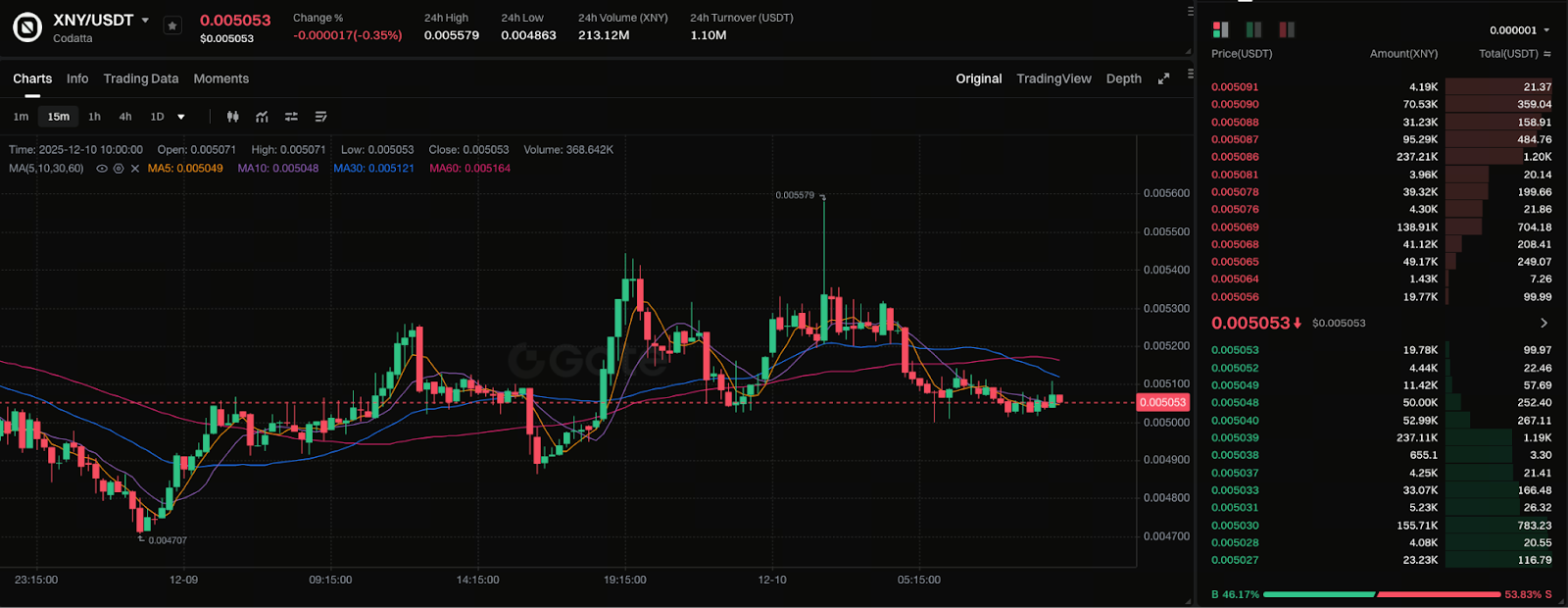
Image: https://www.gate.com/trade/XNY_USDT
XNY_USDT has shown notable price volatility in recent sessions. As of December 10, 2025, the token trades at approximately $0.005. Given XNY’s emerging narrative and limited circulating supply, sharp short-term price swings are common. The 24-hour trading volume remains robust, reflecting active market participation, although speculative activity continues to dominate the price structure.
Tokenomics: Circulating Supply, Total Supply, and Release Mechanism
XNY features a substantial total supply, with the current circulating portion still relatively low. This dynamic suggests that future unlocks, team token releases, and ecosystem rewards will all influence market price trends. The tokenomics framework encompasses ecosystem incentives, team allocations, and market expansion funds—each impacting future supply-demand dynamics and price stability.
Price Drivers: Short-Term Catalysts and Event-Driven Factors
XNY’s price is shaped by factors like the momentum in the data assetization sector, pace of project development, token release schedules, and exchange-driven activities. Announcements of new partnerships, feature rollouts, or data reward initiatives typically boost XNY trading volume in the short term. Conversely, large-scale unlocks or adverse market news can exert downward pressure on the price.
Investment Opportunities and Risks: Who Should Consider XNY?
XNY_USDT is well-suited for traders seeking high volatility and short-term opportunities. However, those targeting stable returns should carefully weigh the associated risks. Strategies such as phased entry, small position sizing, and stop-loss orders are recommended to mitigate uncertainty. Long-term investors should focus on the project’s ability to expand its real-world use cases over time.
Conclusion: XNY’s Potential and Limitations
In summary, XNY offers compelling narrative appeal and long-term prospects in the data assetization space. However, it faces challenges from the early-stage market environment, circulating supply structure, and price volatility. Investors should tailor their strategies according to individual risk preferences and remain attentive to project updates and ecosystem developments.
Share
Content
XNY Project Overview: Codatta’s Core Vision
Latest Market Update: XNY_USDT Price Range and Market Performance
Tokenomics: Circulating Supply, Total Supply, and Release Mechanism
Price Drivers: Short-Term Catalysts and Event-Driven Factors
Investment Opportunities and Risks: Who Should Consider XNY?
Conclusion: XNY’s Potential and Limitations


Related Articles

2025 BTC Price Prediction: BTC Trend Forecast Based on Technical and Macroeconomic Data

Flare Crypto Explained: What Is Flare Network and Why It Matters in 2025

Pi Coin Transaction Guide: How to Transfer to Gate.com

How to Use a Crypto Whale Tracker: Top Tool Recommendation for 2025 to Follow Whale Moves

What is N2: An AI-Driven Layer 2 Solution