


the price of BTC
What Is Bitcoin (BTC)?
Bitcoin is a decentralized peer-to-peer electronic cash system with the ticker symbol BTC. It operates on a distributed ledger maintained collectively by nodes worldwide, independent of any government or corporate issuer.
Bitcoin leverages the Proof of Work (PoW) consensus mechanism and the SHA-256 hashing algorithm to secure the network against double-spending and tampering. New BTC are created through a process known as “mining.” The protocol enforces a maximum supply of 21 million coins, ensuring scarcity—a key factor in its value proposition as a store of value.
Bitcoin (BTC) Price, Market Cap, and Circulating Supply
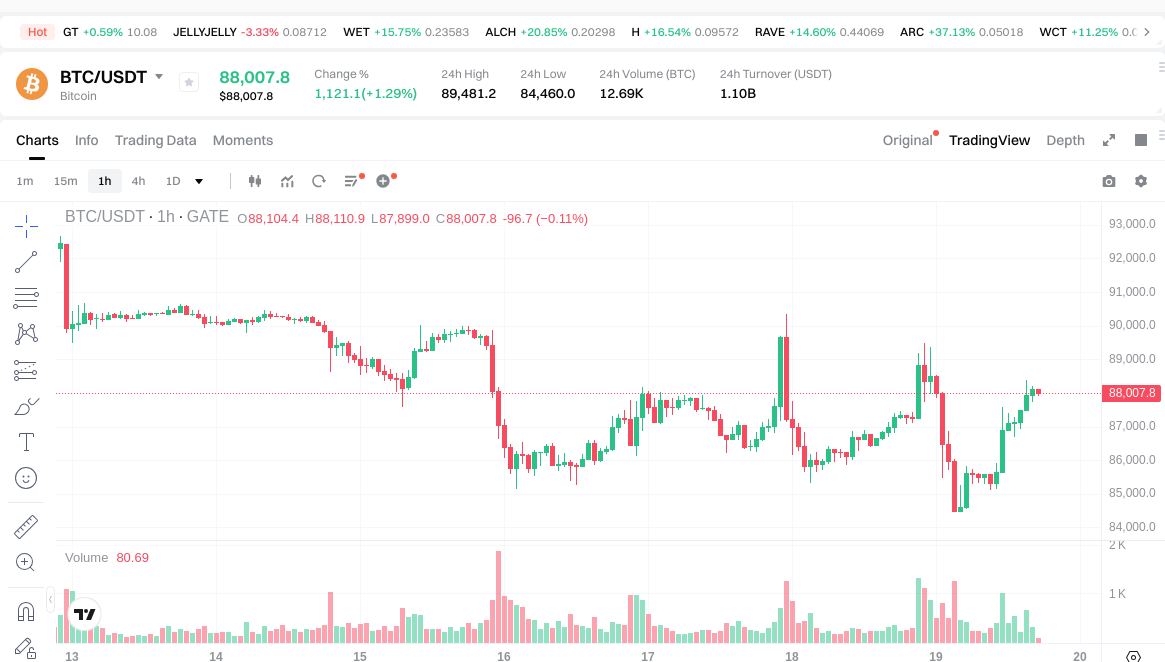
As of 2025-12-19 09:13 UTC, Bitcoin’s price stands at $87,937.856038. Circulating supply is 19,964,121 BTC, with total supply matching at 19,964,121 BTC and a hard cap of 21,000,000 BTC. Its market capitalization is $1,755,601,998,414.52, with a fully diluted market cap at $1,846,694,976,788.86, representing a market dominance of 59.2875%. Source: platform input data; last updated: 2025-12-19T09:13:00Z.
Price performance:
- 1 hour: -0.0265%
- 24 hours: 1.2580%
- 7 days: -4.7727%
- 30 days: -3.6690%
24-hour trading volume is $58,880,267,446.99 across 12,503 trading pairs, indicating high liquidity and active trading. Market dominance reflects Bitcoin’s share of the total crypto market cap; fully diluted market cap estimates potential valuation at maximum supply.
Click to view BTC USDT Price
Who Created Bitcoin (BTC) and When?
Bitcoin was introduced by an individual or group under the pseudonym “Satoshi Nakamoto.” The whitepaper, “Bitcoin: A Peer-to-Peer Electronic Cash System,” was published on October 31, 2008 (source: bitcoin.org). The genesis block was mined on January 3, 2009, marking the official launch of the Bitcoin network.
The “Launch Date” field on this page shows 2010-07-13, likely referring to when Bitcoin was listed on certain data or trading platforms, not the network’s inception. Since launch, Bitcoin has undergone several “halving” events—where block rewards are reduced by half approximately every four years—further reinforcing its scarcity by controlling new issuance.
How Does Bitcoin (BTC) Work?
Bitcoin records transactions on a blockchain: a chronological chain of blocks where each node can verify and store a copy.
Proof of Work (PoW) requires miners to compute SHA-256 hashes to find a random number that meets a difficulty target. Miners compete to package transactions into new blocks, earning block rewards plus transaction fees. Network difficulty dynamically adjusts based on total hash rate to target an average block time of about 10 minutes.
Bitcoin uses the UTXO (Unspent Transaction Output) model: every transaction consumes old UTXOs and creates new ones, allowing for efficient parallel verification and simplified account states. Transactions are signed with private keys; signatures are verified with public keys; addresses—typically starting with “1”, “3”, or “bc1”—are derived from public keys.
What Can You Do with Bitcoin (BTC)?
Bitcoin is widely used as a store of value and for long-term holding due to its capped supply and global liquidity.
For cross-border payments and remittances, users can transfer BTC internationally, bypassing traditional intermediaries. Settlement times depend on network confirmations. For retail payments, some merchants accept BTC; settlement relies on network confirmation speed and transaction fees.
As a portfolio asset, Bitcoin serves as a hedge against fiat currency depreciation or inflation risks—but high price volatility means users should assess their risk tolerance.
Main Risks and Regulatory Considerations of Bitcoin (BTC)
Price Volatility: Bitcoin prices are highly sensitive to market sentiment, macro liquidity changes, and policy shifts—significant short-term fluctuations are common.
Regulation & Compliance: Tax reporting, anti-money laundering (AML), and consumer protection standards differ by country. Users must comply with local laws when buying or holding BTC.
Custody & Private Key Risks: Storing BTC on custodial platforms exposes you to counterparty risks; self-custody requires secure management of your private key or mnemonic phrase—loss or exposure can result in permanent asset loss.
Network & Fees: On-chain transaction fees vary with congestion; confirmation times depend on block space demand. Always select the correct network (BTC mainnet) and address format to avoid misdirected transfers.
Security & Scams: Beware of fake wallets, phishing sites, and high-yield scams. Never send funds to unknown or unverified addresses.
Where Does Bitcoin’s (BTC) Long-Term Value Come From?
A capped supply and halving cycles enforce scarcity, giving Bitcoin “digital gold” status. Security is underpinned by massive computational power and robust protocol rules—making censorship or tampering extremely difficult.
Network effects arise from growing numbers of holders, nodes, developers, and applications—increasing both liquidity and utility. As a transparent global settlement layer with accessible on-chain data, it offers individuals and institutions a verifiable asset allocation foundation.
From an investment perspective, long-term value is closely linked to diversification strategies, inflationary environments, and compliance progress; ultimately, sustained adoption and strong security remain critical for value realization.
How to Buy and Securely Store Bitcoin (BTC) on Gate
Step 1: Register & Complete KYC. Go to Gate’s official website, create an account, enable two-factor authentication (2FA), and complete KYC as instructed for enhanced security and higher limits.
Step 2: Deposit Funds. You can deposit fiat currency or transfer stablecoins like USDT from another wallet before exchanging them for BTC on the spot market. After depositing, verify your account balance.
Step 3: Select Trading Pair & Place Order. Search for “BTC” in the spot trading section and choose your preferred pair (e.g., BTC/USDT). Use market orders for instant execution or set limit orders with your desired price and amount.
Step 4: Check Fills & Fees. After order execution, check your BTC balance in the asset section. Review trading fees and withdrawal charges to avoid incurring excessive costs from frequent small transactions.
Step 5: Withdraw to Self-Custody Wallet. For long-term holding, transfer BTC from Gate to your personal wallet. Choose “BTC” mainnet, paste the correct Bitcoin address (typically starting with “bc1”, “1”, or “3”), test with a small transfer first before sending larger amounts.
Step 6: Secure Storage & Backup. Use a hardware wallet or compliant self-custody solution; back up your mnemonic phrase offline securely. Set up withdrawal whitelists and limits; keep wallet software up-to-date.
How Is Bitcoin (BTC) Different from Ethereum?
Purpose & Functionality: Bitcoin primarily serves as a store of value and decentralized settlement layer. Ethereum (ETH), in contrast, is a programmable smart contract platform supporting DeFi, NFTs, and various decentralized applications.
Consensus Mechanism: Bitcoin utilizes PoW with SHA-256; since Ethereum’s 2022 “Merge,” it now employs Proof of Stake (PoS), securing consensus via staking. This leads to differences in energy usage, security assumptions, and economic incentives.
Programmability & Scaling: Ethereum natively supports smart contracts and a broader application ecosystem; Bitcoin’s scripting is more restrictive by design for security and simplicity—scalability is typically achieved through Layer 2 solutions or protocol upgrades.
Supply & Economics: Bitcoin’s supply is capped at 21 million; Ethereum has no fixed upper limit but features base fee burning (EIP-1559) and issuance/burn balancing via staking. Their models for inflation and scarcity differ fundamentally.
Fees & Performance: Both chains see fluctuating fees and confirmation times during congestion. Bitcoin prioritizes resilience and censorship resistance; Ethereum focuses on programmability and ecosystem growth—each has distinct trade-offs.
Summary of Bitcoin (BTC)
Bitcoin’s fixed supply cap, PoW-secured network, and globally auditable ledger establish it as the leading foundation for value storage and cross-border settlement in crypto. Its dominant market position reflects core status among digital assets—yet price volatility, compliance requirements, and private key management risks remain significant considerations. For allocation, align purchase strategies with personal risk tolerance and investment horizon; consider dollar-cost averaging without leverage; prioritize account security and self-custody backup; always verify network/address details and retain transfer records for safer holdings.
FAQ
How should beginners handle BTC’s high price volatility?
Significant BTC price swings are normal—driven by market sentiment, policy changes, and large trades. Beginners may use dollar-cost averaging (regular fixed-amount purchases) to reduce volatility risk and avoid buying highs or panic selling lows. Set clear take-profit and stop-loss targets; avoid impulsive reactions to short-term moves.
Why does the BTC price react to halving events?
A halving occurs every 210,000 blocks when miners’ block rewards are cut in half. This reduces new BTC issuance—potentially driving prices higher if demand remains steady. Historically, major price swings have occurred around halving events, making them closely watched by investors.
Is there correlation between BTC’s price and other cryptocurrencies?
BTC is often seen as the “bellwether” for the crypto market—its price direction typically influences other coins. When BTC rises, altcoins often follow; when BTC drops, the broader market feels pressure too. This correlation makes BTC’s price action an important indicator for overall market trends.
Where can I find real-time accurate BTC price information?
Real-time BTC prices are available on major exchanges like Gate via live market pages showing latest trades, 24-hour changes, candlestick charts, etc. For cross-platform comparisons, use data aggregators like CoinGecko or CoinMarketCap to ensure accuracy.
What are the main factors influencing BTC price?
Key factors include:
- Supply-demand dynamics (halving, miner sell pressure)
- Macro environment (inflation rates, monetary policy)
- Regulatory developments (national stances)
- Technology upgrades (network improvements)
- Market sentiment (large whale activity, media narratives)
Understanding these drivers helps in interpreting price movements.
Key Bitcoin (BTC) Terms
- Mining: The process of validating transactions through computational competition to earn new coins.
- Proof of Work (PoW): Consensus mechanism used by Bitcoin requiring computational effort to solve cryptographic puzzles.
- Blockchain: Distributed public ledger recording all Bitcoin transactions.
- Halving: Block rewards are cut in half approximately every four years to control supply growth.
- Hash Rate: Metric representing total computational power securing the network.
- UTXO: Unspent Transaction Output model forming the basis of Bitcoin’s ledger structure.
Further Reading & References
-
Official Site / Whitepaper:
-
Developer Resources / Documentation:
-
Leading Media / Research:
Share
Related Articles

In-depth Explanation of Yala: Building a Modular DeFi Yield Aggregator with $YU Stablecoin as a Medium

What is ORDI in 2025? All You Need to Know About ORDI
