This content is provided by a sponsor.
For years, decentralized finance has largely developed around assets native to smart contract platforms such as Ethereum. Meanwhile, major digital assets like XRP have remained largely outside decentralized finance markets despite their large market capitalization and global holder base. Bridging that gap requires new technical frameworks capable of enabling programmable finance while preserving the security of assets on their original chains. A growing ecosystem built around XRP-based decentralized finance, often referred to as XRPFi, is now emerging through infrastructure developed by the Flare network.
Why XRP Has Historically Been Absent From DeFi
XRP has long been one of the largest digital assets by market capitalization and one of the most widely held tokens in the crypto ecosystem. However, participation in DeFi markets has historically been limited.
The primary reason lies in architecture. Unlike assets issued on smart contract networks, XRP was designed for fast settlement and payments on the XRP Ledger rather than for programmable financial applications. As a result, traditional DeFi primitives such as lending markets, automated market makers, and yield strategies were not easily accessible to XRP holders.
This limitation created a structural divide. While DeFi ecosystems grew rapidly on networks such as Ethereum, Solana, and Avalanche, large pools of XRP liquidity remained largely idle from a DeFi perspective.
Infrastructure networks designed to enable interoperability and programmable finance are now beginning to close that gap.
What Flare Network Is Building
Flare Network is a Layer-1 blockchain designed to provide infrastructure for programmable finance, particularly for assets that lack native smart contract functionality.
The network combines several technical components intended to enable decentralized applications to access external data and interact with assets from other blockchains. This architecture allows tokens such as XRP to participate in DeFi environments while remaining secured on their original networks.
Key components of the Flare Network infrastructure include:
FAssets
- FAssets enable assets such as XRP to be represented on Flare while remaining secured on their native chains.
- FXRP represents XRP within the Flare ecosystem through a 1:1 minting system.
- The architecture incorporates over-collateralized minting, non-custodial design, and transparent solvency monitoring on-chain.
Flare Time Series Oracle (FTSO)
- FTSO provides decentralized price feeds integrated directly into the network layer.
- The oracle infrastructure supplies reliable market data used by decentralized exchanges, lending protocols, and other financial applications.
Flare Data Connector (FDC)
- FDC enables the verification of cross-chain and external data events.
- This functionality allows decentralized applications to interact with information originating from other blockchains or Web2 systems.
Flare Smart Accounts (FSA)
- Flare Smart Accounts allow users from other blockchain ecosystems to interact with applications on Flare without requiring entirely new wallets or separate gas tokens.
- The system maps external wallet addresses to Flare Smart Accounts on Flare, enabling integrations such as Xaman wallet, which allows XRP holders to access XRPFi directly from their existing XRPL wallets.
- Together, these components create a technical framework designed to enable cross-chain financial activity and data-driven applications.
FXRP and the Emergence of XRPFi
A key component enabling XRP participation in decentralized finance is FXRP, a 1:1 representation of XRP issued on Flare. The asset allows XRP holders to interact with DeFi applications while the underlying collateral remains secured on the XRP Ledger. Since its introduction in September 2025, FXRP has become the foundation of an expanding XRPFi ecosystem spanning decentralized exchanges, lending markets, and yield strategies.
Recent ecosystem metrics include:
- More than 132 million FXRP minted
- Approximately 80% of FXRP is deployed in DeFi
- Over $200 million in total value locked
- More than 850,000 active addresses are interacting with the network
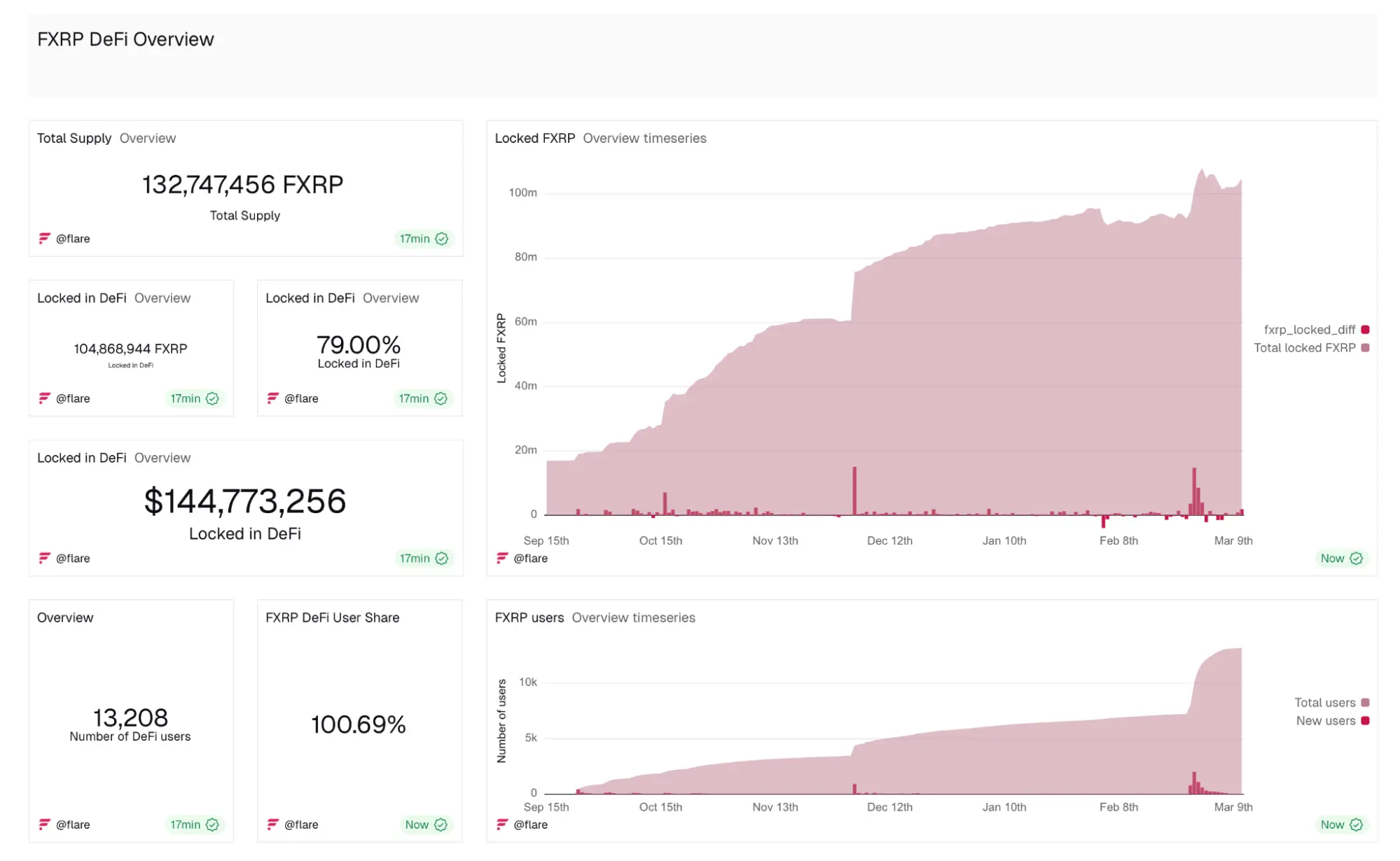
These figures indicate rising engagement among XRP holders seeking exposure to DeFi-based financial tools.
Applications currently integrating FXRP include:
Decentralized exchanges
Money markets
Derivatives platforms
Staking and yield protocols
- Firelight staking infrastructure
- earnXRP yield vault operated by Upshift Finance with risk governance from Clearstar Labs
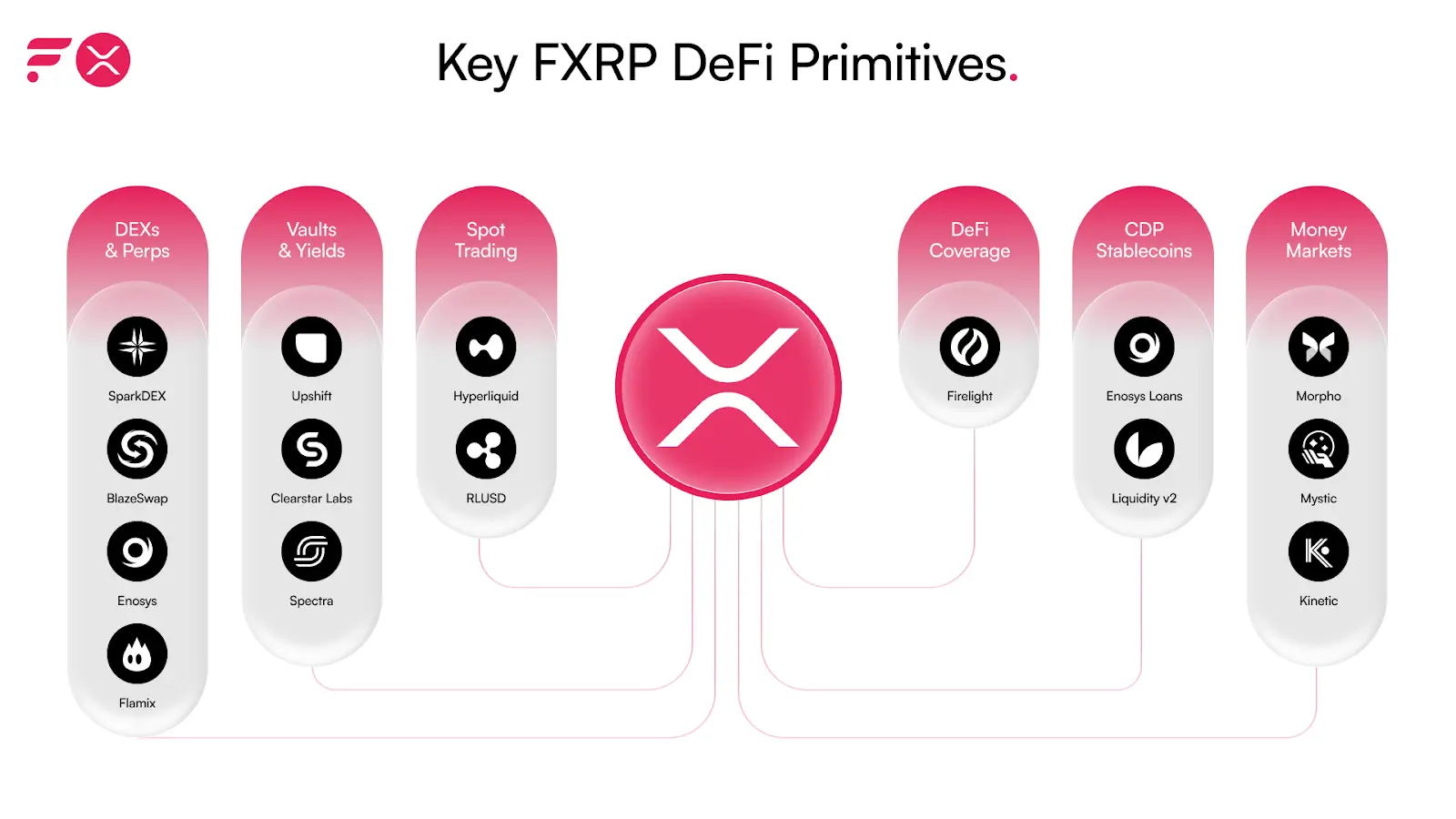
The resulting ecosystem is increasingly referred to as XRPFi, representing decentralized finance activity centered on XRP liquidity.
Xaman Integration Lowers Barriers to Participation
One of the largest recent developments in the XRPFi ecosystem arrived in February 2026 through an integration between Flare and Xaman, a widely used self-custodial wallet in the XRP ecosystem.
The integration allows Xaman wallet users to deposit XRP into a DeFi yield vault directly from the wallet interface, removing the need for manual bridging or additional account setup.
Early activity following the launch indicates that reducing technical complexity can significantly increase participation.
According to ecosystem data recorded after launch:
- More than 6 million FXRP were minted within the first 24 hours
- More than 2,000 wallets participated during that period
- Many participants represented first-time users of Flare-based DeFi
Additional wallet cohort analysis revealed another notable trend. XRP wallets that had remained inactive for two to three years recorded a significant increase in activity following the integration.
These patterns indicate that accessibility has likely been the primary barrier preventing XRP holders from participating in DeFi.
By far the most interesting stat about the $XRP Yield @XamanWallet+@FlareNetworks product is the user base that comes back to open the app:
24h unique users: up, mild peak
30d unique users: same
1y: normal
2y: slightly up
3y: massive peak
Holders for 2-3 years coming back 💪🏼 pic.twitter.com/cEKZ3Gio2T
— Wietse Wind – 🪝🛠 Xaman® + XRPL + Xahau (@WietseWind) March 3, 2026
Upshift Vault Demand and Ecosystem Growth
One of the primary early products enabling XRPFi participation has been the Flare earnXRP yield vault operated by Upshift, with strategy risk governance provided by Clearstar.
The vault allows FXRP deposited through Xaman’s Flare Smart Accounts integration to be allocated across curated DeFi strategies on the Flare network, generating yield for participants.
Following the launch of the Xaman integration, demand for the vault increased rapidly. The Upshift vault recently reached its current capacity of approximately 25 million FXRP.
Additional capacity expansions are expected as strategies continue to scale. Users interested in future vault access or XRPFi ecosystem updates can follow Flare’s official channels for announcements regarding upcoming capacity increases and ecosystem developments.
Unlocking Dormant Liquidity in Established Digital Assets
The XRPFi ecosystem illustrates a broader trend within digital asset infrastructure: the effort to connect established blockchain networks with programmable financial markets.
Many major cryptocurrencies were originally designed for specific use cases such as payments, settlement, or store-of-value functions. As decentralized finance continues to evolve, new infrastructure layers are emerging to allow these assets to participate in on-chain financial activity.
Reducing user interface complexity plays a critical role in expanding DeFi participation. Wallet integrations, simplified asset representations, and automated bridging mechanisms can significantly lower the technical barriers traditionally associated with DeFi participation.
As infrastructure networks mature, these integrations are positioned to unlock large pools of dormant liquidity held by long-term digital asset holders.
Conclusion
The integration between Xaman and Flare demonstrates how infrastructure development can expand decentralized finance access to assets beyond traditional smart contract ecosystems.
Early adoption metrics suggest that simplified access to DeFi tools may activate previously inactive wallets and introduce long-term holders to new financial use cases. As the XRPFi ecosystem continues to expand, infrastructure platforms enabling cross-chain programmable finance may play an increasingly important role in connecting established digital assets with emerging on-chain markets.
Additional information about the Flare infrastructure stack and XRPFi ecosystem can be explored through Flare Network resources at: https://flare.network.
_________________________________________________________________________
Bitcoin.com accepts no responsibility or liability, and shall not be liable, whether directly or indirectly, for any loss, damage, claim, cost, or expense of any kind, whether actual, alleged, or consequential, arising out of or in connection with the use of, or reliance upon, any content, goods, or services referenced in this article. Any reliance placed on such information is strictly at the reader’s own risk.


