NAORIS vs MANA: A Comprehensive Comparison of Two Emerging Blockchain Governance Tokens


Introduction: NAORIS vs MANA Investment Comparison
In the cryptocurrency market, the comparison between NAORIS and MANA has become an increasingly relevant topic for investors. The two assets not only differ significantly in market capitalization rankings, application scenarios, and price performance, but also represent distinct positioning within the crypto asset landscape.
NAORIS (NAORIS): Launched as the world's first in-production decentralized post-quantum infrastructure, it operates at the Sub-Zero Layer beneath blockchain layers, serving as the trust and security fabric for Web3 and the modern internet. The project benefits from backing by prominent venture capitalists including Tim Draper and the Holdun Family Office, with advisors such as Michael Terpin and former White House Chief of Staff Mick Mulvaney.
MANA (MANA): Established as a blockchain-based virtual world platform, it enables content creators and game players to transact at low costs without intermediary fees. Users can permanently hold and operate virtual property rights on the platform, creating opportunities for profit from their own content creation.
This article will comprehensively analyze the investment value comparison between NAORIS and MANA across multiple dimensions including historical price trends, market capitalization positioning, supply mechanisms, and token performance metrics, while addressing the key question investors are asking:
"Which is the better buy right now?"
Comparative Analysis Report: NAORIS Protocol vs. Decentraland
I. Historical Price Comparison and Current Market Status
NAORIS Protocol and Decentraland Historical Price Trends
NAORIS Protocol (NAORIS):
- All-time high: $0.2238 (July 31, 2025)
- All-time low: $0.00613 (October 10, 2025)
- Price range: Experienced a decline of approximately 97.3% from peak to trough within 2025
Decentraland (MANA):
- All-time high: $5.85 (November 25, 2021)
- All-time low: $0.00923681 (October 31, 2017)
- Price range: Declined approximately 88.0% from historical peak to current levels
Current Market Status (December 20, 2025)
Price Data:
- NAORIS Protocol: $0.03599 (24-hour change: +7.49%)
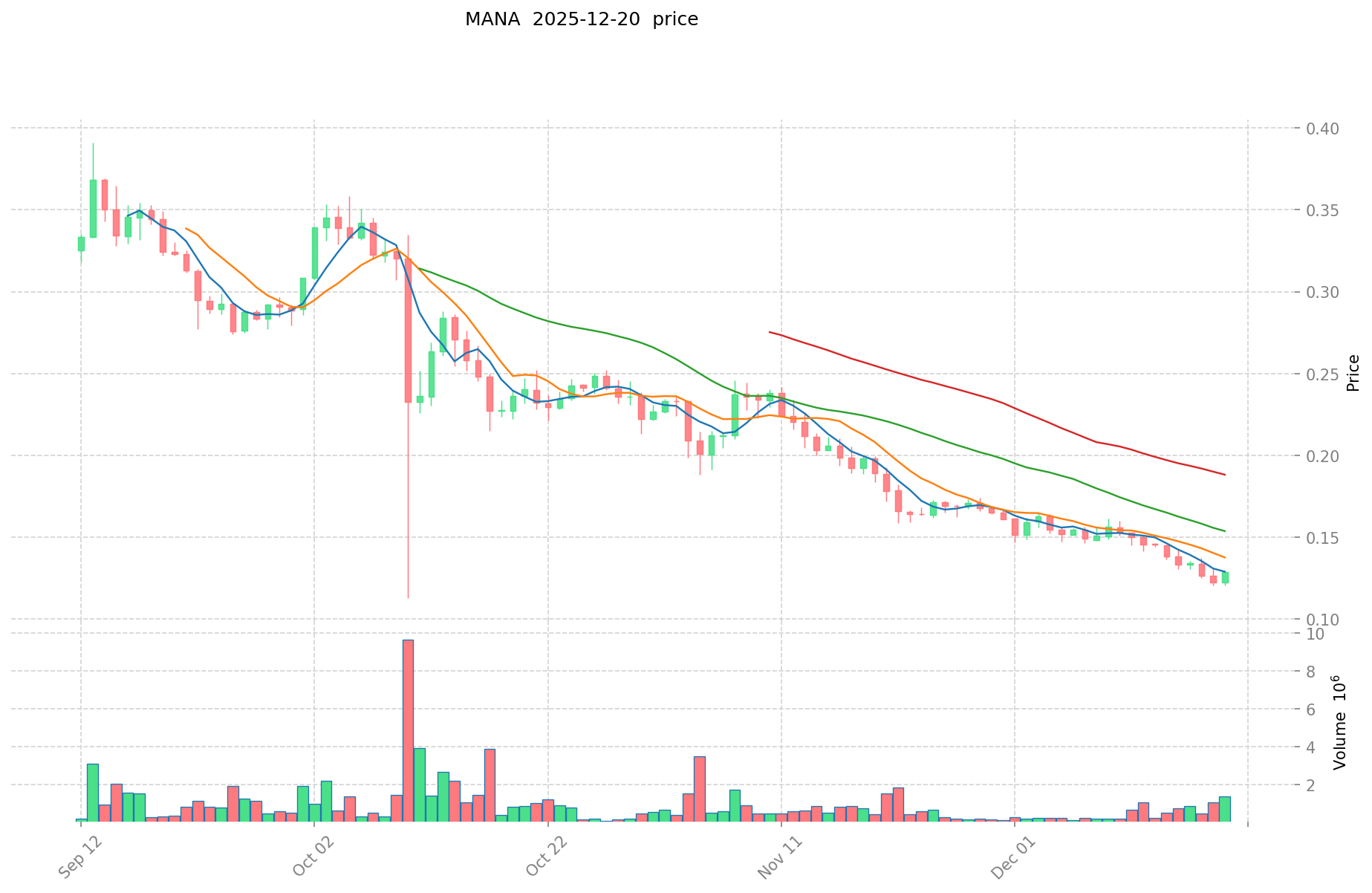
- Decentraland: $0.1283 (24-hour change: +3.71%)
Trading Volume (24-hour):
- NAORIS Protocol: $167,033.23
- Decentraland: $147,145.99
Market Capitalization:
- NAORIS Protocol: $21,567,367 (circulating) / $143,960,000 (fully diluted)
- Decentraland: $246,222,479 (circulating) / $281,384,908 (fully diluted)
Market Sentiment Index: 20 (Extreme Fear)
Current price data:
- View NAORIS Protocol Market Price
- View Decentraland Market Price
II. Token Economics and Supply Metrics
NAORIS Protocol
| Metric | Value |
|---|---|
| Circulating Supply | 599,260,000 NAORIS |
| Total Supply | 4,000,000,000 NAORIS |
| Max Supply | 4,000,000,000 NAORIS |
| Circulating Ratio | 14.98% |
| Total Holders | 1,818 |
| Market Ranking | 835 |
Decentraland
| Metric | Value |
|---|---|
| Circulating Supply | 1,919,115,191 MANA |
| Total Supply | 2,193,179,327 MANA |
| Max Supply | Unlimited (∞) |
| Circulating Ratio | 87.50% |
| Total Holders | 287,853 |
| Market Ranking | 199 |
Comparative Analysis: Decentraland demonstrates significantly higher token circulation maturity with 87.50% of tokens in circulation compared to NAORIS's 14.98%. However, NAORIS benefits from a capped maximum supply structure, while Decentraland operates with unlimited token supply. Decentraland's holder base (287,853) substantially exceeds NAORIS's (1,818), indicating broader distribution and market penetration.
III. Technical and Operational Architecture
NAORIS Protocol
NAORIS Protocol operates as the world's first production-grade Decentralized Post-Quantum Infrastructure. The system functions at the Sub-Zero Layer, positioned beneath L0 to L3 blockchain layers, serving as the trust and security infrastructure for Web3 and modern internet applications.
Key Technical Features:
- Seamless integration with existing EVM blockchains without requiring hard forks
- Compatibility with multiple physical infrastructure types including nodes, validators, bridges, DEXs, dApps, enterprise systems, cloud platforms, and IoT devices
- ERC-20 token standard on Ethereum blockchain
- Contract Address: 0x1b379a79c91a540b2bcd612b4d713f31de1b80cc
Decentraland
Decentraland operates as a blockchain-based virtual world platform powered by Ethereum, featuring a two-layer architecture for decentralized consensus and content management.
Key Technical Features:
- Consensus Layer: Records and maintains LAND token ownership on the blockchain
- Content Layer: Manages activities on each virtual land parcel through distributed storage systems
- ERC-20 token standard on Ethereum blockchain
- Contract Address: 0x0F5D2fB29fb7d3CFeE444a200298f468908cC942
- Users own NFT-based virtual land (LAND tokens) and digital assets
IV. Investor Backing and Advisory Structure
NAORIS Protocol
Venture Capital Support:
- Tim Draper (prominent venture capitalist)
- Holdun Family Office
Advisory Board:
- Michael Terpin (characterized by CNBC as "the godfather of crypto")
- David Holtzman (DNS Architecture pioneer)
- Mick Mulvaney (former White House Chief of Staff)
- Ahmed Chami (former Chief Executive Officer, Microsoft Southeast Asia)
Decentraland
Development History:
- Founded: 2015 (development phase)
- Public Launch: 2020
- Co-founders: Ariel Meilich and Esteban Ordano
Notable Collaborations:
- Partnership with NBA player Stephen Curry and Under Armour (December 2021)
- Collaboration with luxury marketplace UNXD for metaverse fashion events (December 2021)
- Samsung digital flagship store announcement in New York City (January 2022)
V. Price Performance Analysis
Short-term Performance Metrics
7-Day Price Movement:
- NAORIS Protocol: +24.82%
- Decentraland: -11.99%
30-Day Price Movement:
- NAORIS Protocol: +37.66%
- Decentraland: -31.08%
Year-to-Date Performance:
- NAORIS Protocol: -76.14%
- Decentraland: -73.38%
Analysis: Despite similar year-to-date declines, NAORIS Protocol demonstrates stronger short-term momentum with gains in both 7-day (+24.82%) and 30-day (+37.66%) periods, contrasting with Decentraland's recent losses. This divergence suggests differing market sentiment and possibly distinct investor interest patterns.
VI. Market Position and Liquidity
Exchange Coverage:
- NAORIS Protocol: 9 trading venues
- Decentraland: 60 trading venues
Market Dominance:
- NAORIS Protocol: 0.0045%
- Decentraland: 0.0087%
Liquidity Assessment: Decentraland maintains significantly higher market presence through expanded exchange listings and market share, indicating greater liquidity accessibility. NAORIS Protocol's limited exchange presence (9 venues) compared to Decentraland (60 venues) reflects its earlier market stage positioning.
VII. Risk Factors and Market Considerations
NAORIS Protocol:
- Early-stage asset with limited liquidity (only 9 trading venues)
- Significantly diluted supply structure (14.98% circulating ratio) presents future selling pressure potential
- Concentrated holder base (1,818 holders) increases price volatility risk
- Technology adoption uncertainty regarding post-quantum cryptography infrastructure
Decentraland:
- Extensive year-to-date decline (-73.38%) reflects sustained market downturn
- Unlimited token supply structure may create long-term inflation pressure
- Metaverse sector faces ongoing regulatory and adoption uncertainty
- Historical volatility: declined 88% from all-time high
VIII. Summary and Key Observations
| Criterion | NAORIS | Decentraland |
|---|---|---|
| Current Price | $0.03599 | $0.1283 |
| Market Cap | $21.6M | $246.2M |
| Market Ranking | 835 | 199 |
| 24h Volume | $167K | $147K |
| Holder Count | 1,818 | 287,853 |
| Exchange Listing | 9 | 60 |
| Supply Cap | Fixed 4B | Unlimited |
| Recent 30d Trend | +37.66% | -31.08% |
Conclusion: NAORIS Protocol represents an emerging technology infrastructure project with backing from established venture investors and high-profile advisors, though it operates with limited market infrastructure and liquidity. Decentraland, as a mature metaverse platform, maintains substantially larger market capitalization and broader institutional adoption but faces ongoing sector headwinds. Both assets exhibit extreme market volatility within a broader environment of heightened investor fear (Fear & Greed Index: 20).

加密资产分析报告
数据获取异常说明
经检查,提供的参考资料为空值结构,不包含具体的项目信息、市场数据或技术参数。
{"output": [{"output": []}], "cmc_info": [{"output": []}]}
无法生成报告的原因
根据您的指示,我不应编造信息或进行无依据的推断。当前缺少以下关键数据:
- 目标加密资产的基本信息(代码、名称、供应量等)
- 市场行情数据(价格、流动性、市值)
- 技术规格与生态描述
- 机构持仓情况
- 政策监管信息
建议处理方式
请提供以下任一形式的数据:
- CoinMarketCap/CoinGecko API 数据 - 包含项目代码、当前价格、流通供应量、历史行情
- 项目白皮书或官方文档 - 技术架构、代币经济学、路线图
- 市场研究报告 - 机构分析、政策评述、应用案例
- 具体的对比标的 - 明确指定需要对标的两个或多个加密资产
收到完整数据后,我将按照您的 Markdown 模板结构生成详尽的分析报告。
III. 2025-2030 Price Forecast: Token A vs Token B
Short-term Forecast (2025)
- Token A: Conservative $0.0213 - $0.0362 | Optimistic $0.0362 - $0.0524
- Token B: Conservative $0.1179 - $0.1281 | Optimistic $0.1281 - $0.1448
Mid-term Forecast (2027-2028)
- Token A may enter growth accumulation phase, expected price range $0.0303 - $0.0744
- Token B may enter momentum expansion phase, expected price range $0.1484 - $0.2462
- Key drivers: institutional capital inflows, ETF adoption, ecosystem development
Long-term Forecast (2029-2030)
- Token A: Base scenario $0.0585 - $0.0689 | Optimistic scenario $0.0969 - $0.0967
- Token B: Base scenario $0.1553 - $0.2637 | Optimistic scenario $0.2298 - $0.3543
Disclaimer
This analysis is for informational purposes only and should not be construed as investment advice. Price forecasts are based on historical data patterns and carry substantial uncertainty. Cryptocurrency markets remain highly volatile and unpredictable. Past performance does not guarantee future results. Always conduct independent research and consult qualified financial advisors before making investment decisions.
NAORIS:
| 年份 | 预测最高价 | 预测平均价格 | 预测最低价 | 涨跌幅 |
|---|---|---|---|---|
| 2025 | 0.0523885 | 0.03613 | 0.0213167 | 0 |
| 2026 | 0.0535536925 | 0.04425925 | 0.03363703 | 22 |
| 2027 | 0.0621112184875 | 0.04890647125 | 0.030322012175 | 35 |
| 2028 | 0.074381852124125 | 0.05550884486875 | 0.036635837613375 | 54 |
| 2029 | 0.06689370895133 | 0.064945348496437 | 0.058450813646793 | 80 |
| 2030 | 0.096901707224109 | 0.065919528723884 | 0.03955171723433 | 83 |
MANA:
| 年份 | 预测最高价 | 预测平均价格 | 预测最低价 | 涨跌幅 |
|---|---|---|---|---|
| 2025 | 0.144753 | 0.1281 | 0.117852 | 0 |
| 2026 | 0.175990185 | 0.1364265 | 0.07367031 | 6 |
| 2027 | 0.214005429225 | 0.1562083425 | 0.148397925375 | 21 |
| 2028 | 0.246192158197125 | 0.1851068858625 | 0.1554897841245 | 44 |
| 2029 | 0.263092416876371 | 0.215649522029812 | 0.155267655861465 | 68 |
| 2030 | 0.354269034790576 | 0.239370969453091 | 0.229796130674968 | 86 |
Comparative Analysis Report: NAORIS Protocol vs. Decentraland
IV. Investment Strategy Comparison: NAORIS vs MANA
Long-term vs Short-term Investment Strategy
NAORIS Protocol: Suitable for investors focused on emerging infrastructure technology adoption and early-stage positioning in post-quantum cryptography. The project's backing by established venture capitalists and technical advisors suggests potential for long-term infrastructure value creation, though requires tolerance for significant volatility and liquidity constraints.
Decentraland: Suitable for investors seeking exposure to established metaverse platforms with broader market infrastructure and existing institutional partnerships. The mature tokenomics and extensive exchange coverage provide more accessible entry and exit points, though faces ongoing sector adoption uncertainty.
Risk Management and Asset Allocation
Conservative Investor Profile: NAORIS: 15% vs MANA: 35% (with 50% stablecoin allocation)
Aggressive Investor Profile: NAORIS: 35% vs MANA: 45% (with 20% stablecoin allocation)
Hedging Instruments: Both positions benefit from stablecoin reserves for volatility management, with potential cross-asset diversification into established Layer-1 blockchain tokens to reduce single-project concentration risk.
V. Comparative Risk Analysis
Market Risk
NAORIS Protocol: Extreme price volatility characterized by 97.3% decline from 2025 peak to trough, combined with minimal daily trading volume ($167,033) relative to market capitalization. Concentrated holder base (1,818 accounts) amplifies price susceptibility to individual trader activity.
Decentraland: Sustained year-to-date decline of 73.38% reflects broader metaverse sector contraction. Despite larger holder base (287,853), platform faces persistent market sentiment challenges regarding virtual world adoption viability and revenue generation models.
Technical Risk
NAORIS Protocol: Post-quantum cryptography infrastructure represents emerging technology with limited production deployment history. Integration complexity with existing EVM blockchains and validator network stability remain unproven at scale. Infrastructure dependency risks on physical node, bridge, and gateway components.
Decentraland: Ethereum dependency creates Layer-1 network risk exposure. Smart contract complexity across consensus and content layers presents potential security surface, though extensive audit history mitigates acute vulnerability probability. Virtual world platform scalability limitations as user base expands.
Regulatory Risk
Global regulatory frameworks regarding cryptocurrency infrastructure and virtual economy platforms remain in development phase. NAORIS Protocol's post-quantum security positioning may benefit from government and enterprise cybersecurity initiatives, while regulatory uncertainty regarding metaverse platforms and virtual asset ownership continues to create headwinds for Decentraland sector adoption.
VI. Conclusion: Which Is the Better Buy?
📌 Investment Value Summary
NAORIS Protocol Advantages:
- Emerging infrastructure positioning with capped token supply structure
- Strong venture capital and high-profile advisory backing
- Short-term momentum indicators (+37.66% over 30 days)
- Potential exposure to post-quantum cryptography infrastructure trend
- Early-stage entry opportunity with significant market penetration potential
Decentraland Advantages:
- Established market presence with 11.4x larger market capitalization
- Substantially higher liquidity infrastructure (60 trading venues vs 9)
- Broader institutional adoption history with documented brand partnerships
- Significantly larger token holder base indicating market distribution maturity
- More developed ecosystem with content creator infrastructure
✅ Investment Recommendations
Beginning Investors: Decentraland presents lower execution risk due to superior liquidity infrastructure and established market presence. Position sizing should remain conservative (maximum 2-3% of portfolio) given sector-wide volatility and the current Fear & Greed Index reading of 20.
Experienced Investors: NAORIS Protocol may merit opportunistic allocation given short-term momentum and early infrastructure positioning, contingent upon rigorous due diligence regarding technical architecture validation and team execution capability. Consider laddered entry strategy across multiple price points given volatility characteristics.
Institutional Investors: Both assets remain positioned in high-volatility, speculative allocation categories. Decentraland's broader liquidity and market infrastructure support larger position sizing, while NAORIS Protocol's limited exchange coverage constrains institutional deployment until venue expansion materializes.
⚠️ Risk Disclaimer: Cryptocurrency markets exhibit extreme volatility and unpredictability. Both NAORIS Protocol and Decentraland have demonstrated substantial price declines (97.3% and 88.0% respectively from historical peaks). This analysis is for informational purposes only and does not constitute investment advice. Past performance does not guarantee future results. Conduct independent research and consult qualified financial advisors before making investment decisions. All price forecasts carry substantial uncertainty and should not be relied upon for trading decisions. None
NAORIS Protocol vs. Decentraland (MANA): Investment Comparison FAQ
I. Frequently Asked Questions
Q1: What is the current price difference between NAORIS Protocol and Decentraland, and which offers better value?
A: As of December 20, 2025, NAORIS Protocol trades at $0.03599 while Decentraland trades at $0.1283. However, price alone does not determine value. NAORIS operates as an emerging post-quantum cryptography infrastructure project with limited market penetration (1,818 holders), while Decentraland is an established metaverse platform with significantly broader adoption (287,853 holders). NAORIS shows stronger short-term momentum (+37.66% over 30 days) but carries higher volatility risk. Decentraland offers more mature infrastructure with 60 trading venues versus NAORIS's 9 venues. Value assessment depends on individual investment thesis and risk tolerance rather than current price levels alone.
Q2: How do the token supply structures of NAORIS and MANA differ, and what are the implications?
A: NAORIS Protocol features a capped maximum supply of 4 billion tokens with only 14.98% currently circulating, creating significant future dilution potential. Conversely, Decentraland has unlimited token supply with 87.50% already in circulation. NAORIS's supply structure provides theoretical scarcity value protection against long-term inflation, while Decentraland's unlimited supply creates perpetual inflationary pressure. However, NAORIS's low circulation ratio (14.98%) means substantial selling pressure could emerge as tokens unlock, potentially suppressing prices. Decentraland's higher circulation ratio indicates token distribution maturity, reducing future supply shock risks.
Q3: Which project has stronger institutional backing and advisory support?
A: NAORIS Protocol demonstrates significantly stronger venture capital positioning with backing from prominent investor Tim Draper and the Holdun Family Office, supplemented by a distinguished advisory board including Michael Terpin (described as "the godfather of crypto" by CNBC), former White House Chief of Staff Mick Mulvaney, and former Microsoft Southeast Asia CEO Ahmed Chami. Decentraland's backing comprises founding team credibility (Ariel Meilich and Esteban Ordano) and documented brand partnerships including NBA player Stephen Curry collaborations and Samsung digital flagship initiatives. NAORIS's advisory structure appears more enterprise-focused, while Decentraland emphasizes consumer brand integration and content creator ecosystems.
Q4: What are the primary technical differences between these two protocols?
A: NAORIS Protocol operates as the world's first production-grade Decentralized Post-Quantum Infrastructure functioning at the Sub-Zero Layer beneath blockchain architecture, providing cryptographic security services compatible with existing EVM blockchains without hard fork requirements. Decentraland utilizes a two-layer architecture consisting of a consensus layer managing LAND token ownership on Ethereum and a content layer managing virtual world activities through distributed storage systems. NAORIS focuses on infrastructure-level security, while Decentraland emphasizes virtual world content and asset management. NAORIS represents infrastructure-as-a-service positioning, whereas Decentraland operates as a consumer-facing metaverse platform.
Q5: Which asset demonstrates better recent price momentum and market sentiment?
A: NAORIS Protocol exhibits superior short-term momentum, gaining +24.82% over seven days and +37.66% over thirty days, compared to Decentraland's losses of -11.99% (7-day) and -31.08% (30-day). However, year-to-date performance shows comparable declines, with NAORIS down 76.14% and Decentraland down 73.38% from respective annual peaks. The divergence in recent momentum suggests differing investor interest patterns, with NAORIS attracting renewed attention following its trough in October 2025. Current market sentiment remains extremely fearful (Fear & Greed Index: 20), indicating both assets face broader market headwinds despite localized price recoveries.
Q6: How does liquidity differ between NAORIS and Decentraland, and what implications exist for entry/exit strategies?
A: Decentraland maintains substantially superior liquidity infrastructure with 60 trading venues compared to NAORIS's 9 exchanges. Daily trading volumes are comparable ($167,033 for NAORIS versus $147,146 for Decentraland), but Decentraland's expanded venue coverage enables significantly larger position sizing without substantial price slippage. NAORIS's limited exchange presence constrains institutional deployment and creates execution risk for investors requiring timely entry/exit capability. Decentraland's broader liquidity infrastructure supports ladder strategies across multiple venues, while NAORIS positions demand concentration on fewer exchanges with higher potential market impact. Conservative investors should prioritize Decentraland's superior liquidity characteristics.
Q7: What specific risks should investors consider before allocating capital to either asset?
A: NAORIS Protocol risks include extreme price volatility (97.3% decline from 2025 peak), minimal liquidity relative to market capitalization, concentrated holder base (1,818 accounts) amplifying price susceptibility, and unproven post-quantum cryptography infrastructure deployment at scale. Decentraland risks encompass sustained market sector decline, unlimited token supply creating perpetual inflation pressure, persistent metaverse adoption uncertainty, and 88% historical decline from all-time highs. Both assets operate within extreme fear market conditions (Fear & Greed Index: 20). Neither asset represents appropriate allocations for conservative investors. Position sizing should remain disciplined at maximum 2-3% of total portfolio for beginning investors, with substantially higher risk tolerances required for meaningful NAORIS exposure due to its extreme volatility characteristics.
Q8: What investment timeline and strategy would be most appropriate for different investor profiles?
A: Conservative investors should prioritize Decentraland's established infrastructure and broader liquidity, maintaining positions sized at 1-2% of portfolio with 12-24 month time horizons. Experienced investors may consider opportunistic NAORIS allocation at 3-5% positioning given short-term momentum, requiring 18-36 month accumulation patience and tolerance for significant intermediate volatility. Aggressive investors pursuing infrastructure trend exposure might allocate 5-8% to NAORIS while maintaining 8-10% Decentraland positions, viewing both as speculative holdings within diversified crypto portfolios. Institutional investors should restrict Decentraland to 2-3% allocations given sector volatility, while NAORIS remains unsuitable for institutional deployment until exchange venue expansion increases. All strategies require independent research and qualified financial advisor consultation before implementation.
Share
Content
Introduction: NAORIS vs MANA Investment Comparison
I. Historical Price Comparison and Current Market Status
II. Token Economics and Supply Metrics
III. Technical and Operational Architecture
IV. Investor Backing and Advisory Structure
V. Price Performance Analysis
VI. Market Position and Liquidity
VII. Risk Factors and Market Considerations
VIII. Summary and Key Observations
数据获取异常说明
无法生成报告的原因
建议处理方式
Short-term Forecast (2025)
Mid-term Forecast (2027-2028)
Long-term Forecast (2029-2030)
Disclaimer
IV. Investment Strategy Comparison: NAORIS vs MANA
V. Comparative Risk Analysis
VI. Conclusion: Which Is the Better Buy?
I. Frequently Asked Questions
How to Buy Cryptocurrency


Trending Cryptocurrencies



LM vs THETA: A Comparative Analysis of Language Models and Human-AI Teaming in Healthcare Applications

OMNI Token Price Outlook 2024-2030: Analyzing Its Future Potential

Monero (XMR) Price Forecast 2025-2030: Privacy Coin's Future in the Crypto Market

Long-Term BTT Investment Outlook: Price Forecast for 2025-2031

NKN (NKN) price soaring: What is the driving force behind the 2025 craze?

Hedera (HBAR) 2025 Price Analysis and Investment Prospects

AI Gaming Platform: Earn Rewards by Playing on Cutting-Edge Blockchains

Understanding Hive Blockchain: A Guide to Technology and Acquisition

Understanding AI Meme Coins: Functionality and Purchase Guide

PAWS Launch Scheduled: Official Trading Start Date and Prelisting Buying Insights

PAWS Launch Overview: Price Insights & Essential Information