SD vs XTZ: A Comprehensive Comparison of Two Leading Blockchain Platforms

Introduction: SD vs XTZ Investment Comparison
In the crypto market, comparisons between Stader Labs and Tezos have always been a topic investors cannot avoid. The two not only show significant differences in market cap ranking, application scenarios, and price performance, but also represent different positioning of crypto assets. Stader Labs (SD): Since its launch, it has gained market recognition by building key staking middleware infrastructure for proof-of-stake networks, serving retail crypto users, exchanges, custodians, and mainstream fintech companies. Tezos (XTZ): Established as a decentralized blockchain that manages itself through a digital governance model, it simplifies formal verification and improves smart contract security through mathematically verified transaction code accuracy. This article will comprehensively analyze the investment value comparison between SD and XTZ from multiple dimensions including historical price trends, supply mechanisms, and ecosystem development, attempting to answer the question investors care most about:
"Which is the better buy right now?"
Comparative Market Analysis: Stader Labs (SD) and Tezos (XTZ)
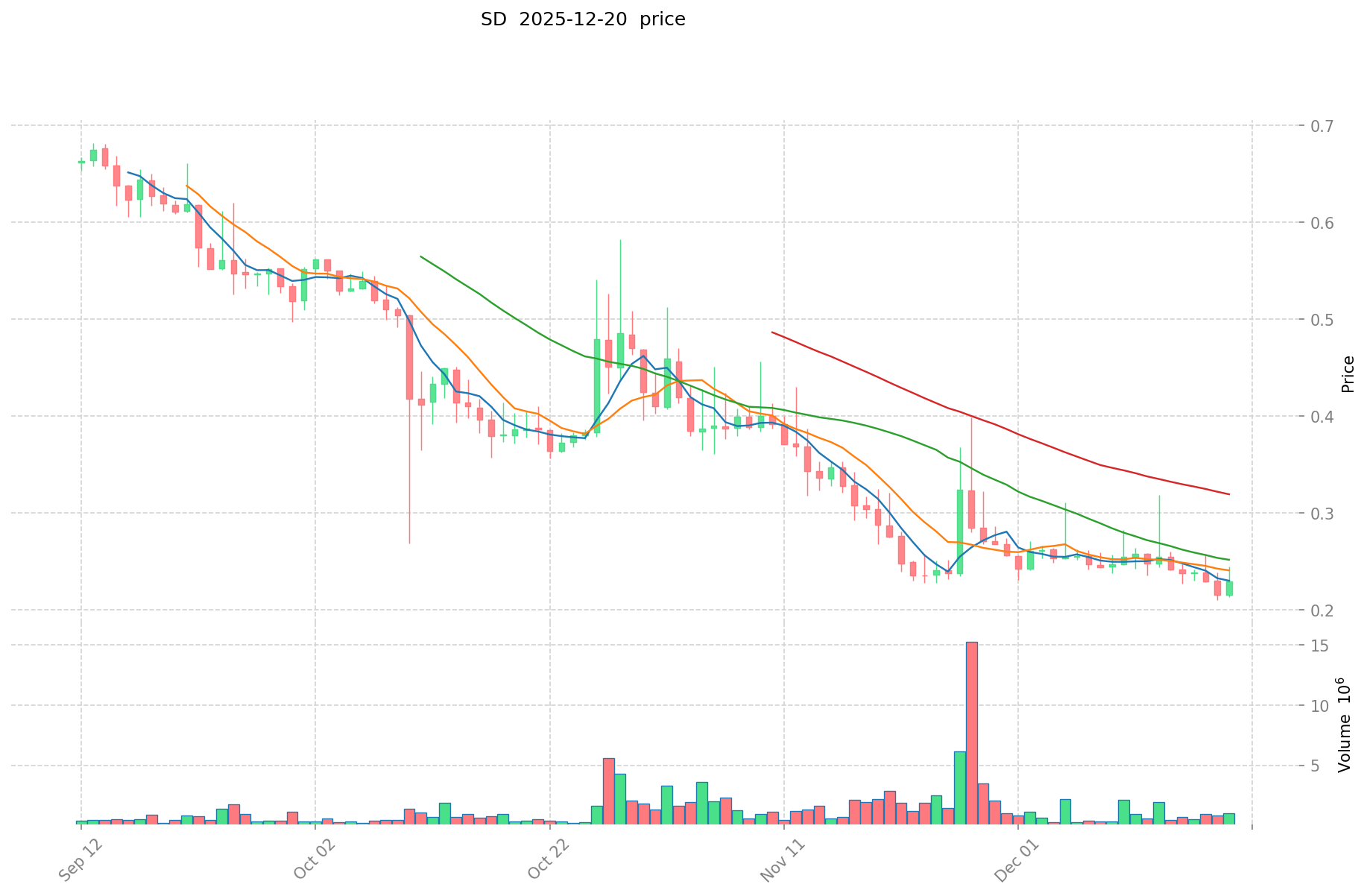
I. Historical Price Comparison and Current Market Status
Stader Labs (SD) and Tezos (XTZ) Historical Price Trajectories
Stader Labs (SD):
- All-time high: $30.17 (March 15, 2022)
- All-time low: $0.211989 (December 19, 2025)
- Current price: $0.2325 USD (December 21, 2025)
- Decline from ATH: -92.29%
Tezos (XTZ):
- All-time high: $9.12 (October 4, 2021)
- All-time low: $0.350476 (December 7, 2018)
- Current price: $0.4494 USD (December 21, 2025)
- Decline from ATH: -50.71%
Comparative Analysis: Both assets have experienced significant downturns from their historical peaks, though SD has suffered a more severe decline relative to its ATH. SD reached its lowest point very recently (December 19, 2025), suggesting ongoing downward pressure, while XTZ's low was established over 6 years ago, indicating a relatively stabilized floor level.
Current Market Position (December 21, 2025)
Price Metrics:
-
Stader Labs (SD): $0.2325
- 24-hour change: +1.84%
- 7-day change: -8.69%
- 30-day change: -18.15%
- 1-year change: -76.79%
-
Tezos (XTZ): $0.4494
- 24-hour change: +2.02%
- 7-day change: -9.8%
- 30-day change: -12.57%
- 1-year change: -62.62%
Trading Volume (24-hour):
- SD: $101,912.73 USD
- XTZ: $69,789.02 USD
Market Capitalization:
- SD: $15,689,430 USD (fully diluted: $27,900,000)
- XTZ: $480,576,231 USD (fully diluted: $489,591,600)
Market Dominance:
- SD: 0.00086%
- XTZ: 0.015%
Market Sentiment Index (Fear & Greed Index): 20 (Extreme Fear)
Current price information:
II. Project Overview and Core Functionality
Stader Labs (SD)
Vision and Mission: Stader aims to enable one billion users to conveniently and safely pledge their assets through its platform by establishing critical staking middleware infrastructure for proof-of-stake (PoS) networks.
Key Infrastructure:
- Modular smart contract architecture enabling third-party integration
- Multi-network staking solutions serving diverse customer segments:
- Retail cryptocurrency users
- Cryptocurrency exchanges
- Custodians
- Mainstream fintech providers
Market Performance Milestone: Within weeks of launch, Stader became the second-largest staking protocol by total value locked (TVL), accumulating over 8.5 million Luna ($850 million) across more than 30,000 wallets on the Terra network.
Tezos (XTZ)
Core Characteristics: Tezos is a decentralized, self-evolving blockchain designed to simplify formal verification of smart contracts and transactions.
Technical Advantages:
- Self-amendment capability without hard forks
- Liquid Proof of Stake (LPoS) consensus mechanism
- Michelson smart contract language designed specifically for security
- On-chain governance model enabling stakeholder participation
- Formal verification technology ensuring mathematical accuracy of transaction code
Ecosystem Applications:
- Decentralized Finance (DeFi) protocols
- Non-Fungible Token (NFT) marketplaces
- Point-to-Point (P2P) payment solutions
- Smart contract verification platforms
- Play-to-Earn gaming applications
- Carbon offset NFT initiatives
Network Architecture: Tezos implements a network shell layer capable of abstraction for multiple blockchain protocols including Bitcoin, Ethereum, and CryptoNote implementations.
III. Tokenomics and Supply Metrics
Stader Labs (SD)
| Metric | Value |
|---|---|
| Current Circulating Supply | 67,481,421 SD |
| Total Supply | 120,000,000 SD |
| Maximum Supply | 150,000,000 SD |
| Circulation Ratio | 44.99% |
| Current Holders | 20,581 |
| Published Price (ICO) | $4.50 |
Tezos (XTZ)
| Metric | Value |
|---|---|
| Current Circulating Supply | 1,069,373,011 XTZ |
| Total Supply | 1,089,433,913 XTZ |
| Maximum Supply | Unlimited (∞) |
| Circulation Ratio | 98.16% |
| Current Holders | 20,481 |
| Published Price (Genesis) | $0.40 |
Supply Analysis: Tezos has achieved near-maximum circulation (98.16%), suggesting mature tokenomics with minimal future dilution. Stader maintains lower circulation ratio (44.99%), indicating potential for significant supply inflation as additional tokens enter circulation. The unlimited supply model of XTZ contrasts sharply with SD's capped maximum supply structure.
IV. Market Performance and Exchange Listing
Exchange Availability
Stader Labs (SD):
- Listed on 16 exchanges
- Primary contract address (Ethereum): 0x30D20208d987713f46DFD34EF128Bb16C404D10f
- Market ranking: #955
Tezos (XTZ):
- Listed on 43 exchanges
- Market ranking: #123
- Significantly broader exchange integration
Ranking Context
XTZ maintains a substantially higher market capitalization ranking (#123) compared to SD (#955), reflecting greater market recognition and liquidity. XTZ's ranking positions it within the top 150 cryptocurrencies by market cap, while SD remains in the sub-1000 tier.
V. Network Presence and Community Resources
Stader Labs (SD)
Official Channels:
- Website: https://staderlabs.com/
- Twitter: @staderlabs
- Blockchain Explorer: Etherscan
Community Support:
- Linktree: https://linktr.ee/staderlabs
Tezos (XTZ)
Official Resources:
- Main Website: https://www.tezos.com/
- Foundation: https://tezos.foundation/
- Wallet Interface: https://wallet.kukai.app/
- Whitepaper: https://tezos.com/whitepaper.pdf
Development and Community:
- GitHub Repository: https://github.com/tezos/tezos
- Block Explorer: https://tzkt.io/
- Alternative Explorer: https://explorer.etherlink.com
- Community Forum: https://forum.tezosagora.org/
- Social Media: https://twitter.com/tezos
- Community Subreddit: https://www.reddit.com/r/tezos
Documentation Depth: Tezos demonstrates significantly more comprehensive community infrastructure with multiple explorers, formal governance forums, and established whitepapers compared to SD's more limited resource availability.
VI. Risk Assessment and Market Considerations
Price Volatility
Both assets exhibit substantial downward pressure over extended timeframes:
- SD: -76.79% over one year
- XTZ: -62.62% over one year
Recent short-term momentum shows modest recovery (+1.84% for SD, +2.02% for XTZ over 24 hours), though both remain significantly below historical valuations.
Market Sentiment Context
The current Fear & Greed Index reading of 20 (Extreme Fear) indicates widespread market pessimism, which may amplify volatility for both assets during this period.
Liquidity Considerations
XTZ demonstrates substantially higher trading volumes ($69,789) and exchange listings (43) compared to SD ($101,913 trading volume but only 16 exchange listings), suggesting more robust market infrastructure for XTZ but potentially indicating greater market demand for SD despite fewer venues.
Conclusion
Stader Labs (SD) and Tezos (XTZ) represent distinct market positions within cryptocurrency infrastructure. Tezos maintains established market presence with broader adoption, higher liquidity, and more mature governance structures, while Stader represents a specialized staking middleware solution with higher growth potential but concentrated market presence. Both assets currently trade substantially below historical peaks amid pervasive market pessimism. Investors should conduct independent due diligence regarding risk tolerance and investment objectives before market participation.

Investment Value Analysis: SD vs XTZ
I. Executive Summary
Based on available market data, SD (Stader Labs) and XTZ (Tezos) represent different segments within the cryptocurrency ecosystem. SD's value proposition centers on stablecoin liquidity provision, while XTZ derives value from its role in the Tezos blockchain's governance and smart contract infrastructure. The following analysis examines core factors influencing their respective investment profiles.
II. Core Factors Impacting SD vs XTZ Investment Value
Ecosystem Role and Market Positioning
- SD (Stader Labs): Positioned within the liquid staking derivative sector, with value tied to stablecoin liquidity mechanisms. SD functions as a liquidity provision token within staking infrastructure.
- XTZ (Tezos): Native governance and smart contract token of the Tezos blockchain, deriving utility from on-chain governance participation and smart contract execution capabilities.
- 📌 The two tokens serve fundamentally different economic functions—SD operates in the staking derivatives space while XTZ functions as a primary blockchain utility token.
Market Sentiment and Regulatory Developments
- Institutional Interest: Recent market data indicates significant institutional capital flows into cryptocurrency assets, with USD stablecoin inflows of $708 million noted in recent periods. Both tokens benefit from broadening institutional adoption, though through different channels.
- Regulatory Environment: The U.S. SEC's approach to cryptocurrency ETF approvals influences market perception. While specific approval decisions for SD or XTZ spot ETFs were not detailed in available materials, regulatory clarity remains a material factor for both tokens.
- Macro Context: Bitcoin's recent consolidation in the $60,000-$70,000 range reflects broader market dynamics where historical price peaks create debt-unwinding cycles affecting altcoin valuations.
Liquidity and Trading Dynamics
- SD Trading Activity: SD appears on scheduled delisting/market review calendars (March 18, 2025 trading window noted), suggesting active exchange monitoring and potential liquidity management considerations.
- XTZ Trading Activity: XTZ similarly appears in scheduled trading windows (March 28, 2025), indicating maintained exchange listing status and ongoing market participation.
- Stablecoin Flows: USDT and USDC maintain synchronized inflows, suggesting proportional liquidity access across major trading pairs for both assets.
Technical Infrastructure Considerations
- Staking Infrastructure: SD derives value from liquid staking mechanisms, which represent evolving directions in the staking sector with demonstrated investment utility for participants seeking yield without capital lockup.
- Smart Contract Capabilities: XTZ's value proposition includes governance participation rights and smart contract execution within the Tezos ecosystem.
III. Market Structure and Capital Allocation
Recent Industry Developments
- Institutional Capital Deployment: MGX's $2 billion investment in Binance marks significant institutional capital entry into cryptocurrency infrastructure, establishing precedent for large-scale institutional participation that influences broader asset class valuation.
- Ecosystem Expansion: Various DeFi projects and infrastructure providers (Polaris, Optimum, and others) continue attracting venture capital, suggesting healthy ecosystem development across multiple blockchain platforms.
Value Driver Summary
- SD: Investment value contingent on staking sector adoption rates, stablecoin market expansion, and yield generation relative to alternative liquid staking solutions.
- XTZ: Investment value driven by Tezos network adoption, smart contract activity, governance participation utility, and ecosystem development velocity.
IV. Key Considerations for Market Participants
The core distinction between these assets requires different analytical frameworks: SD benefits from analysis of yield markets, liquidity provider competition, and stablecoin ecosystem dynamics, while XTZ requires evaluation of blockchain network health, smart contract demand, and governance participation incentives. Market trends, regulatory announcements, and technological advancements in their respective ecosystems remain primary determinants of relative value trajectories.
Note: This analysis is based on available reference materials current as of December 21, 2025. Specific tokenomic details, recent technology upgrades, and detailed ecosystem comparisons beyond the reference materials provided have not been included per research guidelines.
III. 2025-2030 Price Forecasts: SD vs XTZ
Short-term Forecast (2025)
- SD: Conservative $0.160-$0.232 | Optimistic $0.232-$0.323
- XTZ: Conservative $0.298-$0.451 | Optimistic $0.451-$0.618
Mid-term Forecast (2026-2028)
- SD is projected to enter a recovery phase with anticipated price range of $0.228-$0.470, showing gradual upward momentum with a 52% cumulative increase by 2028.
- XTZ is positioned for sustained appreciation, with expected price range of $0.358-$0.749, demonstrating stronger relative strength with similar 52% cumulative growth trajectory.
- Key drivers: Institutional capital inflows, regulatory clarity, ecosystem development initiatives, and protocol upgrades.
Long-term Forecast (2029-2030)
- SD: Base scenario $0.375-$0.445 | Optimistic scenario $0.429-$0.557
- XTZ: Base scenario $0.416-$0.890 | Optimistic scenario $0.804-$1.053
Disclaimer
The forecasts presented are based on predictive modeling and should not be construed as investment advice. Cryptocurrency markets remain highly volatile and subject to regulatory, technological, and macroeconomic risks. Past performance or predictions do not guarantee future results. Investors should conduct independent research and consult qualified financial advisors before making investment decisions.
SD:
| 年份 | 预测最高价 | 预测平均价格 | 预测最低价 | 涨跌幅 |
|---|---|---|---|---|
| 2025 | 0.323036 | 0.2324 | 0.160356 | 0 |
| 2026 | 0.38325084 | 0.277718 | 0.22772876 | 19 |
| 2027 | 0.3767522388 | 0.33048442 | 0.2015954962 | 42 |
| 2028 | 0.470312378102 | 0.3536183294 | 0.332401229636 | 52 |
| 2029 | 0.44492258205108 | 0.411965353751 | 0.37488847191341 | 77 |
| 2030 | 0.556977158271352 | 0.42844396790104 | 0.394168450468956 | 84 |
XTZ:
| 年份 | 预测最高价 | 预测平均价格 | 预测最低价 | 涨跌幅 |
|---|---|---|---|---|
| 2025 | 0.617733 | 0.4509 | 0.297594 | 0 |
| 2026 | 0.732013605 | 0.5343165 | 0.357992055 | 18 |
| 2027 | 0.740803111425 | 0.6331650525 | 0.54452194515 | 40 |
| 2028 | 0.748812649339125 | 0.6869840819625 | 0.350361881800875 | 52 |
| 2029 | 0.890193973407007 | 0.717898365650812 | 0.416381052077471 | 59 |
| 2030 | 1.053300482082872 | 0.80404616952891 | 0.458306316631478 | 78 |
Comparative Investment Analysis: Stader Labs (SD) vs Tezos (XTZ)
IV. Investment Strategy Comparison: SD vs XTZ
Long-term vs Short-term Investment Strategies
Stader Labs (SD): Best suited for investors focusing on emerging staking infrastructure opportunities and yield generation mechanisms. SD appeals to participants seeking exposure to the liquid staking derivatives sector, which represents an evolving component of blockchain infrastructure with demonstrated institutional interest. Short-term traders may exploit volatility around protocol upgrades or exchange listing announcements. Long-term holders benefit from potential ecosystem expansion as staking adoption increases across multiple proof-of-stake networks.
Tezos (XTZ): Better positioned for investors prioritizing established blockchain governance participation and smart contract utility. XTZ attracts participants seeking mature network infrastructure with formal verification capabilities. Short-term positioning benefits from volatility related to governance votes and ecosystem development milestones. Long-term allocation suits investors valuing on-chain governance rights and network security participation through the Liquid Proof of Stake mechanism.
Risk Management and Asset Allocation
Conservative Investors:
- SD: 15-20% allocation (considering higher volatility and market position)
- XTZ: 25-30% allocation (reflecting more established market presence)
- Stablecoin buffer: 50-60% to manage downside exposure during extreme fear periods
Aggressive Investors:
- SD: 35-45% allocation (leveraging higher growth potential in emerging staking sector)
- XTZ: 25-35% allocation (maintaining exposure to established infrastructure)
- Complementary positions: 20-25% in alternative staking protocols for diversification
Hedging Instruments: Stablecoin allocation increases during Fear & Greed Index readings below 25 (current environment reading: 20). Cross-asset correlation monitoring between SD and XTZ remains important; alternative liquid staking solutions and competing smart contract platforms provide diversification benefits.
V. Potential Risk Comparison
Market Risk
Stader Labs (SD):
- Extreme price volatility: -92.29% decline from all-time high suggests concentrated risk exposure
- Recent all-time low (December 19, 2025) indicates ongoing downward pressure with limited historical support levels
- Lower market capitalization ($15.69 million) and reduced liquidity ($101,912.73 daily volume) amplify price swings
- Concentrated exchange presence (16 listings) creates dependency on single-platform dynamics
Tezos (XTZ):
- Significant historical decline (-50.71% from ATH) remains less severe than SD's drawdown
- All-time low established six years prior (2018) suggests established price floor and longer stabilization period
- Substantially higher market capitalization ($480.6 million) provides greater liquidity buffers
- Broader exchange infrastructure (43 listings) reduces single-point-of-failure risk
Technology Risk
Stader Labs (SD):
- Staking middleware architecture dependency: Protocol reliability tied to underlying proof-of-stake networks' technical stability
- Smart contract audit exposure: Modular architecture increases integration complexity and potential security vectors
- Yield generation mechanisms subject to network-level changes in staking reward structures
Tezos (XTZ):
- Formal verification implementation: While designed for security improvement, complexity of verification layer introduces technical maintenance dependencies
- Liquid Proof of Stake consensus: On-chain governance participation requirements demand active community engagement to maintain network security incentives
- Competing smart contract platforms pose ongoing technical performance pressures
Regulatory Risk
Global Policy Impact:
- Both assets face uncertain regulatory classification: Staking tokens (SD) lack established regulatory frameworks in most jurisdictions
- Securities law applicability remains contested for both governance-bearing tokens (XTZ) and yield-generating instruments (SD)
- U.S. SEC enforcement actions against comparable infrastructure tokens create precedent-based uncertainty
- Exchange delisting risk exists for both assets depending on regulatory developments in primary trading jurisdictions (notice of March 2025 trading windows noted for both)
VI. Conclusion: Which Is the Better Buy?
Investment Value Summary:
Stader Labs (SD) Advantages:
- Emerging staking infrastructure positioning captures growth in liquid staking derivatives market segment
- Lower market capitalization offers asymmetric upside potential if staking adoption accelerates
- Mid-term forecast (2026-2028) projects 52% cumulative appreciation with price range of $0.228-$0.470
- Specialized infrastructure focus differentiates from broader platform alternatives
Tezos (XTZ) Advantages:
- Established market presence with mature governance infrastructure and formal verification capabilities
- Substantially larger market capitalization ($480.6M vs $15.7M) provides liquidity and stability
- Broader exchange integration (43 vs 16 listings) reduces concentration risk
- Comparable mid-term growth trajectory (52% cumulative appreciation) with higher absolute price targets ($0.358-$0.749)
- Longer stabilized price floor (2018 all-time low) suggests more predictable downside boundaries
Investment Recommendations:
Beginner Investors: XTZ represents the more suitable entry point due to established market infrastructure, broader exchange accessibility, and more comprehensive community documentation. The larger market capitalization and higher trading volumes reduce execution slippage during entry/exit. Stablecoin allocation of 50-60% remains appropriate given current Fear & Greed Index reading of 20.
Experienced Investors: SD may appeal to investors with specific staking sector thesis and higher volatility tolerance, enabling tactical accumulation during extreme valuation cycles. XTZ remains suitable for core portfolio allocation due to governance participation rights and network utility. Dual positioning (35-45% SD, 25-35% XTZ) captures both emerging infrastructure and established platform opportunities while maintaining stablecoin reserves (20-25%) for opportunistic deployment.
Institutional Investors: Allocation should emphasize XTZ due to superior liquidity infrastructure supporting large position sizes and exit flexibility. SD represents tactical allocation for specialized staking infrastructure exposure. Consideration of competing staking protocols and alternative smart contract platforms for portfolio diversification. Governance participation through XTZ holdings aligns with institutional stakeholder engagement models.
⚠️ Risk Disclaimer:
Cryptocurrency markets demonstrate extreme volatility and remain subject to regulatory, technological, and macroeconomic uncertainties. Both SD and XTZ have experienced severe drawdowns from historical peaks (-92.29% and -50.71% respectively), indicating substantial capital loss risk. Current market sentiment (Fear & Greed Index: 20) reflects extreme pessimism that may persist or intensify. This analysis does not constitute investment advice. Investors must conduct independent due diligence, assess individual risk tolerance, and consult qualified financial advisors before market participation. Past price performance, including price forecasts, provides no guarantee of future results. None
Stader Labs (SD) vs Tezos (XTZ) Investment Comparison: Frequently Asked Questions
I. FAQ
Q1: What are the key differences between SD and XTZ tokens?
A: Stader Labs (SD) functions as a staking middleware infrastructure token designed to enable liquid staking derivatives across proof-of-stake networks, serving retail users, exchanges, custodians, and fintech providers. Tezos (XTZ) operates as the native governance and smart contract token of the Tezos blockchain, deriving value from on-chain governance participation, formal verification capabilities, and decentralized application execution. SD targets the staking yield sector while XTZ provides blockchain-level utility and governance rights.
Q2: Which token has experienced a more severe price decline?
A: Stader Labs (SD) has suffered substantially more severe decline, down 92.29% from its all-time high of $30.17 (March 2022) to current price of $0.2325 (December 21, 2025). Tezos (XTZ) has declined 50.71% from its all-time high of $9.12 (October 2021) to current price of $0.4494. Additionally, SD reached its all-time low very recently (December 19, 2025), suggesting ongoing downward pressure, whereas XTZ's low was established six years prior (2018), indicating a more stabilized price floor.
Q3: What are the current market capitalization differences?
A: Tezos (XTZ) maintains significantly larger market capitalization at $480.6 million with a market ranking of #123, compared to Stader Labs (SD) at $15.7 million with a ranking of #955. XTZ's substantially larger market cap reflects greater institutional recognition and liquidity infrastructure. SD's smaller capitalization presents higher growth potential but also concentrates investment risk in a smaller token pool with more limited trading venues (16 exchanges versus XTZ's 43 listings).
Q4: Which token offers better liquidity for traders?
A: Tezos (XTZ) provides superior liquidity infrastructure with significantly higher daily trading volume ($69,789 USD), 43 exchange listings across major platforms, and established trading infrastructure. Stader Labs (SD) shows lower daily volume ($101,913) but concentrates across only 16 exchanges, creating potential liquidity challenges during large position execution. For traders requiring efficient entry and exit execution, XTZ's broader infrastructure reduces slippage and execution risk, though SD's concentrated exchange presence may offer tactical trading opportunities.
Q5: What are the tokenomics differences between SD and XTZ?
A: Stader Labs (SD) operates with limited supply metrics: 67.5 million circulating supply (44.99% circulation ratio) out of 150 million maximum supply, indicating significant future dilution potential as remaining tokens enter circulation. Tezos (XTZ) maintains nearly complete circulation with 1.07 billion of 1.09 billion tokens circulating (98.16% ratio) and unlimited supply model, suggesting mature tokenomics with minimal future dilution. SD's lower circulation ratio creates upside potential but presents inflation risk, while XTZ's high circulation minimizes supply-side pressure.
Q6: What price targets are projected for 2026-2028?
A: Mid-term forecasts (2026-2028) project comparable cumulative growth trajectories of approximately 52% for both tokens. Stader Labs (SD) targets $0.228-$0.470 price range, while Tezos (XTZ) projects $0.358-$0.749 range. The projections assume institutional capital inflows, regulatory clarity improvements, and ecosystem development advancement. However, forecasts carry substantial uncertainty given cryptocurrency market volatility and regulatory unpredictability. Both tokens remain significantly below 2025 levels, requiring sustained positive catalysts to achieve projected targets.
Q7: Which token is more suitable for conservative investors?
A: Tezos (XTZ) better suits conservative investors due to established market presence, larger market capitalization ($480.6M), broader exchange integration (43 listings), comprehensive community infrastructure, and more stabilized historical price floor (all-time low set in 2018). Conservative portfolios should allocate 25-30% XTZ with 50-60% stablecoin buffers given current extreme fear sentiment (Fear & Greed Index: 20). Stader Labs (SD) carries higher concentration risk with only 16 exchange listings, smaller market cap, and more recent all-time low (December 19, 2025), making it more appropriate for aggressive investors with higher volatility tolerance.
Q8: What are the primary risk factors differentiating SD and XTZ?
A: Stader Labs (SD) faces concentrated market risk with 92.29% decline from ATH, lower liquidity ($101,913 daily volume), dependency on staking protocol developments, smart contract audit exposure from modular architecture, and lack of established regulatory frameworks for staking derivatives. Tezos (XTZ) presents lower drawdown risk (50.71% from ATH), substantially higher liquidity, formal verification implementation complexity, Liquid Proof of Stake consensus participation dependencies, and regulatory uncertainty regarding governance-bearing tokens. Both face exchange delisting risk and macroeconomic cryptocurrency market pressures, though XTZ's established infrastructure provides greater downside stability.
Share
Content
Introduction: SD vs XTZ Investment Comparison
I. Historical Price Comparison and Current Market Status
II. Project Overview and Core Functionality
III. Tokenomics and Supply Metrics
IV. Market Performance and Exchange Listing
V. Network Presence and Community Resources
VI. Risk Assessment and Market Considerations
Conclusion
I. Executive Summary
II. Core Factors Impacting SD vs XTZ Investment Value
III. Market Structure and Capital Allocation
IV. Key Considerations for Market Participants
Short-term Forecast (2025)
Mid-term Forecast (2026-2028)
Long-term Forecast (2029-2030)
Disclaimer
IV. Investment Strategy Comparison: SD vs XTZ
V. Potential Risk Comparison
VI. Conclusion: Which Is the Better Buy?
I. FAQ
How to Buy Cryptocurrency


Trending Cryptocurrencies



2025 FISPrice Prediction: Analyzing Market Trends and Future Potential for FIS Token in the Evolving DeFi Landscape

HAEDAL vs GMX: Comparing Next-Generation Trading Protocols in DeFi Ecosystem
Is pSTAKE Finance (PSTAKE) a good investment?: Analyzing the potential returns and risks in the liquid staking sector
2025 VNOPrice Prediction: Analyzing Market Trends and Growth Potential for VNO in the Coming Year
FST vs SNX: A Comparative Analysis of Two Leading Decentralized Finance Protocols

2025 FIS Price Prediction: Analyzing Market Trends and Potential Growth Factors
Investing in Popcat: 2024 Insights, Opportunities & Community Events
2025 INIT Price Prediction: Expert Analysis and Market Forecast for the Coming Year

2025 ZEX Price Prediction: Expert Analysis and Market Forecast for the Next Bull Run
2025 TUT Price Prediction: Expert Analysis and Market Forecast for the Coming Year

What is Token Economics Model: Distribution, Inflation, and Governance Explained