As Web3 applications continue to expand, demand for on-chain data queries is growing rapidly. DeFi protocols need to read transaction records, NFT platforms need to query asset states, and DAO tools need to access governance data. All of these rely on efficient data indexing services. As a decentralized data indexing protocol, The Graph provides developers with the ability to query on-chain data, and the core incentive tool that supports the entire network is GRT.
In The Graph ecosystem, GRT is not merely a trading token. It is an important part of how the network operates. It plays key roles in paying query fees, node staking, and network governance, making it an important medium that connects developers, node operators, and the broader protocol ecosystem. Demand for GRT is directly linked to usage of The Graph network, so its economic model shapes the token’s long-term value logic.
How Important Is GRT in The Graph Ecosystem?
In Web3 infrastructure, tokens often serve to incentivize network participants and keep protocols running. GRT is the value core of The Graph network. Whether developers are querying data or nodes are providing indexing services, GRT is involved.
GRT creates a mechanism where usage generates demand and participation requires staking, allowing The Graph network to continue operating in a decentralized environment. As more developers and DApps use The Graph, demand for GRT payments and staking may grow alongside them. Therefore, GRT is not only the protocol’s utility token, but also an important tool for capturing value within The Graph network.
What Are the Main Uses of GRT?
GRT has three core uses in The Graph network: paying query fees, node staking, and protocol governance.
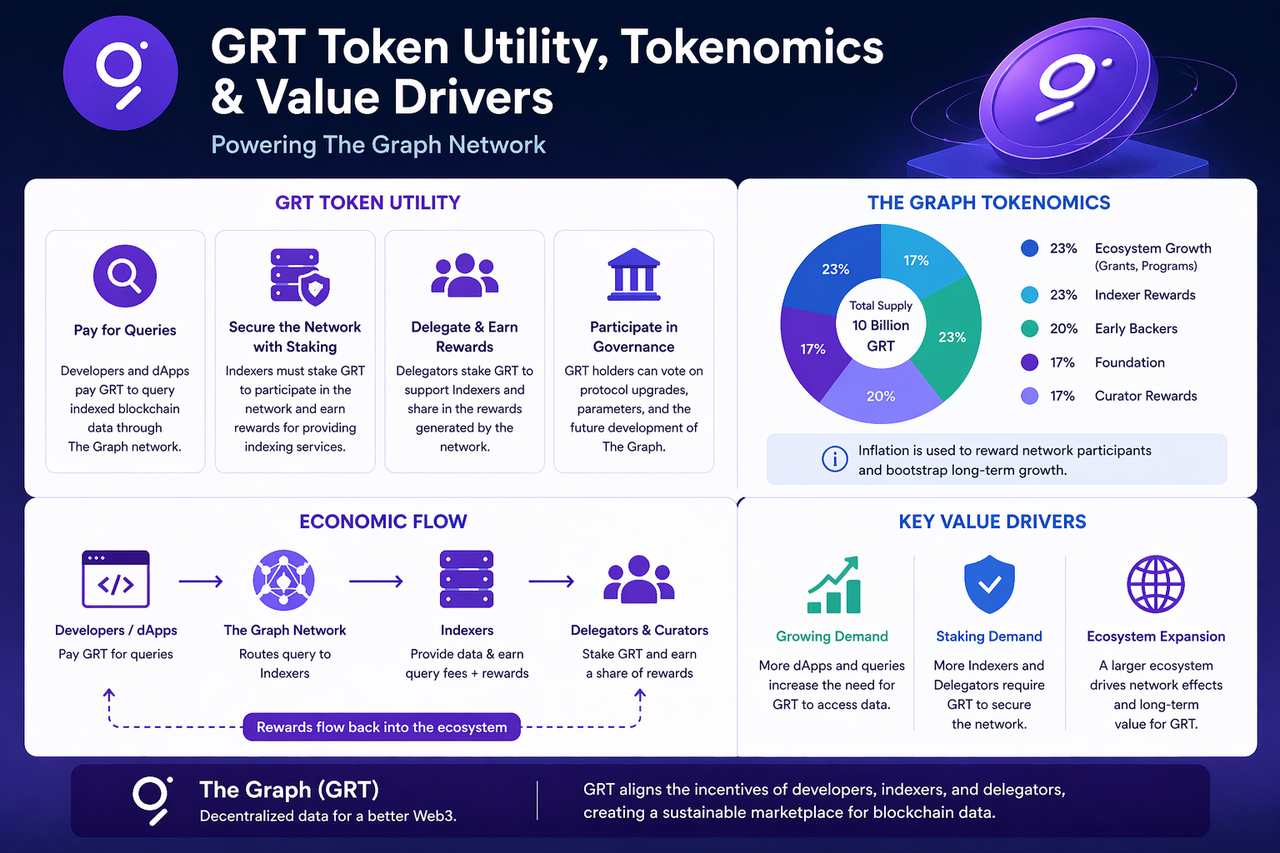
First, developers and decentralized applications need to pay GRT as query fees when using The Graph’s data services. Each data query creates token demand, making GRT an important carrier of value tied to network usage.
Second, network participants such as Indexers, Curators, and Delegators need to stake GRT to take part in protocol operations. Indexers stake GRT to qualify for indexing work, Curators stake GRT to signal high-quality Subgraphs, and Delegators delegate their stake to share in rewards. This mechanism makes GRT an important resource for securing the network and improving its operating efficiency.
In addition, GRT can be used for governance. Token holders can participate in decisions on protocol parameter adjustments and future upgrades, helping The Graph move gradually toward decentralized governance.
How Does the GRT Query Fee Mechanism Create Value?
The Graph’s core business is providing on-chain data query services, and GRT serves as the payment medium for query fees.
When developers query blockchain data through The Graph, they need to pay a certain amount of GRT. These fees are distributed to the Indexer nodes that provide the service. As more DApps use The Graph and network query volume increases, demand for GRT payments may rise as well.
This mechanism resembles a pay-per-use business model. The higher protocol usage becomes, the stronger the demand for GRT, which creates value support. As a result, data query demand on The Graph is one of the most direct sources of value for GRT.
How Does GRT Staking Affect Token Value?
Beyond payment demand, another major source of value for GRT is staking demand.
Indexers must stake GRT to run nodes and provide indexing services, while Delegators and Curators also need to stake GRT to participate in network rewards and resource allocation. This means a large amount of GRT can be locked in the protocol, reducing circulating supply in the market.
As the network grows, the number of participating nodes may increase, raising demand for GRT staking. The staking mechanism not only strengthens network security, but also supports GRT’s value by reducing circulating supply.
How Does The Graph’s Token Economic Model Work?
The Graph’s token economic model mainly revolves around payment demand, staking demand, and incentive distribution.
Query fees paid by developers form protocol revenue. Nodes earn income by providing indexing services, while participants receive rewards by staking GRT. Through economic incentives, the protocol attracts more nodes to participate, helping keep data indexing services stable.
This economic model makes GRT a bridge between protocol users and service providers. The higher network usage becomes, the greater node revenue may be, and the stronger the willingness to participate in staking, creating a positive feedback loop.
What Are the Sources of Value for GRT?
GRT’s value mainly comes from three areas:
The first is growth in data query demand. The more DApps The Graph serves, the greater the data query volume, and the higher the demand for GRT payments.
The second is increased node staking demand. More Indexers and Delegators participating in the network means more GRT is locked.
The third is expectations for ecosystem expansion. If The Graph becomes the data infrastructure for more Web3 applications, its network value may rise, strengthening the market’s long-term expectations for GRT.
Therefore, GRT’s value logic is closely tied to the adoption rate of The Graph protocol.
What Risks Does GRT’s Economic Model Face?
Although GRT’s value logic is clear, its economic model still faces certain risks.
First, if usage growth on The Graph network falls short of expectations, demand for query fees may be insufficient, weakening value support for GRT.
Second, competition in the data indexing infrastructure sector is intense. Other protocols may draw developer demand away, reducing The Graph’s market share.
In addition, token releases and market volatility may also affect GRT’s price performance. Therefore, GRT’s long-term value depends not only on the design of its economic model, but also on the protocol’s actual adoption.
Why Is GRT’s Value Closely Linked to The Graph’s Adoption?
The value of GRT ultimately comes from demand for The Graph network, so protocol adoption is the key factor determining GRT’s long-term value.
If more DeFi, NFT, and DAO projects use The Graph, both query demand and staking demand may increase, and GRT’s economic value may rise accordingly.
Conversely, if protocol growth stagnates, usage demand for GRT will struggle to expand, limiting its room for value growth. Therefore, when assessing whether GRT has long-term potential, the core question is how The Graph’s adoption progresses within the Web3 data layer.
Conclusion
GRT is the core utility token of The Graph network. It is mainly used to pay query fees, support node staking, and participate in protocol governance. Its sources of value mainly include on-chain data query demand, node staking demand, and expectations for ecosystem expansion.
As The Graph becomes more important in Web3 data indexing, demand for GRT may strengthen. However, its long-term value still depends on the protocol’s real adoption rate and network growth.
FAQs
What Is the GRT Token Used For?
GRT is mainly used to pay The Graph’s data query fees, support Indexer node staking, and participate in protocol governance. It is an important tool for keeping The Graph network running.
What Is the Source of GRT’s Value?
GRT’s value mainly comes from growth in data query demand, increased node staking demand, and long-term expectations created by the expansion of The Graph ecosystem.
Why Does Staking Affect the Value of GRT?
Because staking locks a large amount of GRT, reducing circulating supply in the market while strengthening network security. This can provide support for the token’s value.
What Does the Long-Term Value of GRT Depend On?
The long-term value of GRT mainly depends on the adoption rate of The Graph network, meaning how many developers and DApps continue to use its data query services.







