As decentralized exchange (DEX) protocols evolve, the Automated Market Maker (AMM) model has become the core mechanism for on-chain asset trading. Traditional Order Book models rely on matching buyers and sellers, while AMMs leverage liquidity pools to automatically set trading prices, making decentralized asset swaps more efficient. In this evolution, different AMM models have developed distinct paths based on varying asset needs.
Curve and Uniswap are two of the most iconic AMM protocols in DeFi, representing “universal liquidity” and “optimized stable liquidity,” respectively. Each serves as critical infrastructure within the DeFi ecosystem.
What Is Uniswap’s AMM Model?
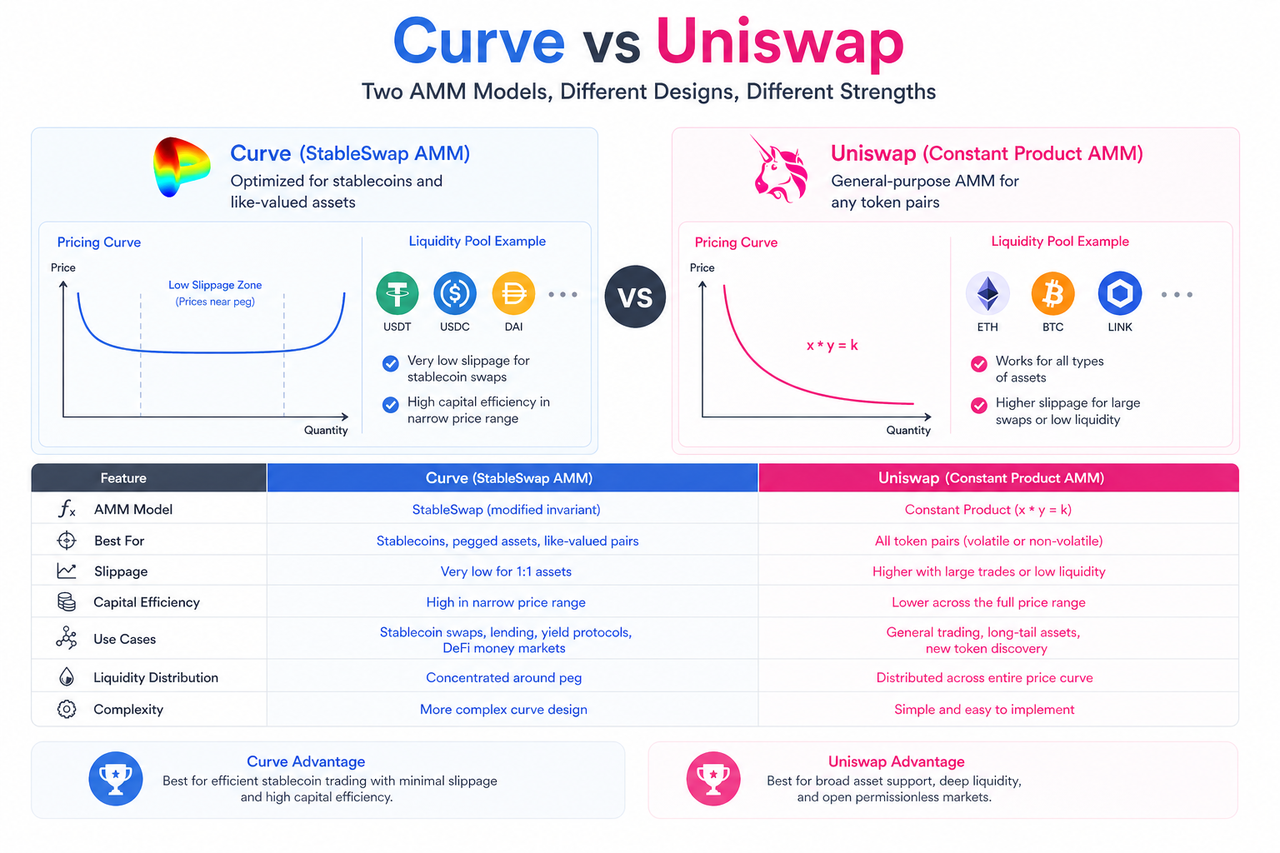
Uniswap utilizes the Constant Product Market Maker model, defined by the formula: x × y = k.
This model maintains a constant product between two assets to determine price. When a user buys one asset, its quantity in the pool decreases while the other asset increases, causing the price to adjust accordingly.
The main advantage of this mechanism is its simplicity, making it suitable for any asset pair. As a result, it serves as the foundational model for general-purpose DEXs. However, because the Price Curve changes continuously, high slippage can occur during periods of low liquidity or large trades.
What Is Curve’s AMM Model?
Curve adopts the StableSwap model, an AMM curve specifically optimized for stablecoins and similar assets. It blends features of the constant product and constant sum models, keeping prices stable when assets are near their pegged values.
This design allows for low-slippage trades between stablecoins—even at high volumes—making Curve ideal for swaps among assets like USDT, USDC, and DAI.
How Curve and Uniswap Differ in Pricing Mechanisms
The core distinction lies in their Price Curve design.
Uniswap’s constant product model maintains a consistent curve shape across all price ranges, so price slippage accelerates quickly as trading volume rises. In contrast, Curve’s StableSwap curve remains flat near the peg and only increases in slope as prices move further away.
In practice:
- Uniswap excels at universal price discovery
- Curve enables low-slippage trading for stable assets
Liquidity Efficiency: Curve vs. Uniswap
Curve offers superior liquidity efficiency for stable assets.
Because stablecoin prices fluctuate within a narrow range, Curve concentrates liquidity around the pegged price, maximizing capital utilization. Uniswap, by spreading liquidity across the entire price range, is less efficient for stable asset trading.
This means Curve typically provides a lower-cost trading experience for stablecoin swaps.
Slippage: Curve vs. Uniswap
Slippage is a key metric for trading costs.
With equal liquidity, Curve’s flatter curve significantly reduces slippage for stable asset trades, while large trades on Uniswap experience more pronounced price changes and higher slippage.
Thus, Curve generally outperforms Uniswap in slippage for high-demand stablecoin trades.
Application Scenarios: Curve vs. Uniswap
While both are DEXs, their optimal use cases differ:
| Comparison Dimension |
Curve |
Uniswap |
| Core Model |
StableSwap |
Constant Product AMM |
| Main Assets |
Stablecoins/Pegged Assets |
Any Assets |
| Slippage Performance |
Low |
Higher |
| Capital Efficiency |
High (Stable Assets) |
General Purpose |
| Main Use |
Stablecoin Swaps |
General Token Trading |
Uniswap is better suited as a universal asset exchange, while Curve is designed as a liquidity infrastructure for stable assets.
Curve and Uniswap’s Roles in DeFi
Uniswap is the general-purpose trading infrastructure in DeFi, providing an open environment for all asset types and serving as a major source of on-chain liquidity.
Curve plays a pivotal role in stablecoin liquidity, powering efficient swap routes for lending protocols, yield aggregators, and stablecoin systems.
In summary:
- Uniswap delivers “broad coverage” for asset trading
- Curve delivers “high-efficiency” stable asset swaps
Together, they form the backbone of the DeFi liquidity ecosystem.
Summary
The core difference between Curve and Uniswap is their AMM model design goals. Uniswap’s constant product model enables universal asset trading, while Curve’s StableSwap model optimizes stablecoin trading efficiency. Uniswap prioritizes market universality; Curve focuses on capital efficiency for stable asset swaps. Understanding these differences is essential for building a comprehensive framework of DeFi liquidity structure.
FAQs
What is the biggest difference between Curve and Uniswap?
The primary difference is the AMM pricing model. Uniswap uses the constant product model, while Curve uses the StableSwap model, which is optimized for stablecoins.
Why does Curve offer lower slippage for stablecoin trades?
Curve concentrates liquidity near the pegged price range of stablecoins, resulting in a smoother Price Curve and reduced slippage.
Is Uniswap suitable for stablecoin trading?
Uniswap can be used for stablecoin trades, but it is generally less efficient than Curve in terms of slippage and capital utilization.
Can Curve trade all assets?
Curve is mainly optimized for stablecoins and similar assets, unlike Uniswap, which supports any asset pair.
What roles do Curve and Uniswap play in DeFi?
Uniswap is a universal DEX liquidity marketplace, while Curve is an optimized liquidity infrastructure for stablecoins.







