As blockchain ecosystems evolved into more complex coordination environments, governance systems needed to move beyond simple voting mechanisms. Many early DAO models faced challenges such as fragmented tooling, weak incentive alignment, and limited flexibility in governance design.
DeXe addresses these challenges by structuring governance as a complete system rather than a standalone voting function. It connects proposal logic, voting rules, delegation, execution, and rewards into a unified operational framework, enabling DAOs to function with greater consistency and transparency. DeXe functions as a modular governance architecture that integrates decision-making, execution, and incentives into a single system for decentralized coordination.
What is the design goal of DeXe?
The design goal of DeXe centers on enabling decentralized organizations to operate through governance systems that are structured, adaptable, and transparent across all stages of coordination.
Rather than treating governance as a standalone voting mechanism, DeXe approaches it as a complete operational framework. It emphasizes coordination quality, flexibility in design, and long-term sustainability, recognizing that effective governance requires more than simply counting votes . It requires systems that can adapt to different organizational needs and evolving conditions.
This approach addresses several structural limitations observed in earlier DAO models:
-
Fragmented governance tools across voting, treasury, and execution layers
-
Limited flexibility in proposal formats and governance rule design
-
Weak recognition of expertise, delegation, and contributor roles
-
Incentive systems that fail to consistently reward meaningful participation
To overcome these challenges, DeXe is built around a set of interconnected design principles:
-
Configurability DAOs can define and adjust governance parameters such as quorum thresholds, voting duration, proposal categories, and execution conditions. This allows governance systems to evolve alongside the organization rather than remain static.
-
Automation Governance processes are implemented through smart contracts, enabling proposals to move from approval to execution without manual intervention. This reduces coordination friction and improves consistency in outcomes.
-
Merit-oriented participation Governance structures incorporate delegation and participation mechanisms that aim to recognize expertise and contribution, rather than relying solely on passive token ownership.
-
Treasury-linked governance Decision-making is directly connected to resource allocation, meaning governance outcomes influence treasury management, funding decisions, and operational direction.
Together, these principles position DeXe as a governance operating framework in which rules, incentives, and execution are tightly integrated. Governance is treated as an ongoing system rather than a series of isolated decisions, allowing decentralized organizations to coordinate more effectively at scale.
DeXe is designed to enable DAOs to function through configurable, automated, and participation-aware governance systems that connect decision-making with execution and treasury control in a continuous and structured manner.
How DeXe handles governance architecture and coordination flow
DeXe organizes governance through a modular architecture that separates system-level coordination, DAO-specific logic, and execution processes into clearly defined layers. This layered structure allows decentralized organizations to manage governance in a flexible yet structured way, where each component handles a specific role while remaining interconnected within a unified system.
At a high level, architecture can be understood as three functional layers:
Core layer Handles protocol-wide elements such as registries, system configuration, and shared logic. This layer ensures consistency across DAOs and maintains the foundational rules that support governance operations.
DAO layer Represents individual organizations where governance takes place. This is where participants interact, proposals are created, voting occurs, and delegation mechanisms are applied.
Proposal and execution layers Manage the lifecycle of governance actions, including proposal handling, validation, and automated execution. These layers ensure that decisions translate into actual system changes.
Together, these layers create a coordinated environment where governance is not isolated but embedded into the operational structure of the DAO.
Within each DAO, governance follows a structured lifecycle that moves decisions from idea to execution:
-
DAO configuration Governance begins with defining key parameters such as quorum thresholds, voting duration, proposal eligibility, and execution conditions. These settings establish the rules of participation and can evolve through governance itself.
-
Proposal submission Participants submit proposals that define specific actions, such as funding allocations, parameter updates, or strategic changes. Proposals can be structured in different formats and may exist on-chain or off-chain depending on the governance design.
-
Voting and delegation Once proposals are active, participants vote using token-based or delegated models. Governance power may come from ERC20 tokens, NFTs, or a combination of both. Delegation allows participants to transfer voting influence to others, enabling expertise-driven decision-making.
-
Validation and execution path After voting concludes, proposals are evaluated against predefined conditions such as quorum and approval thresholds. Some governance designs may include additional validation steps or execution delays, providing time for review or exit before final implementation.
-
Execution and reward distribution Approved proposals are executed automatically through smart contracts. Actions such as treasury transfers or parameter updates are carried out on-chain, and rewards may be distributed to contributors who participated in the governance process.
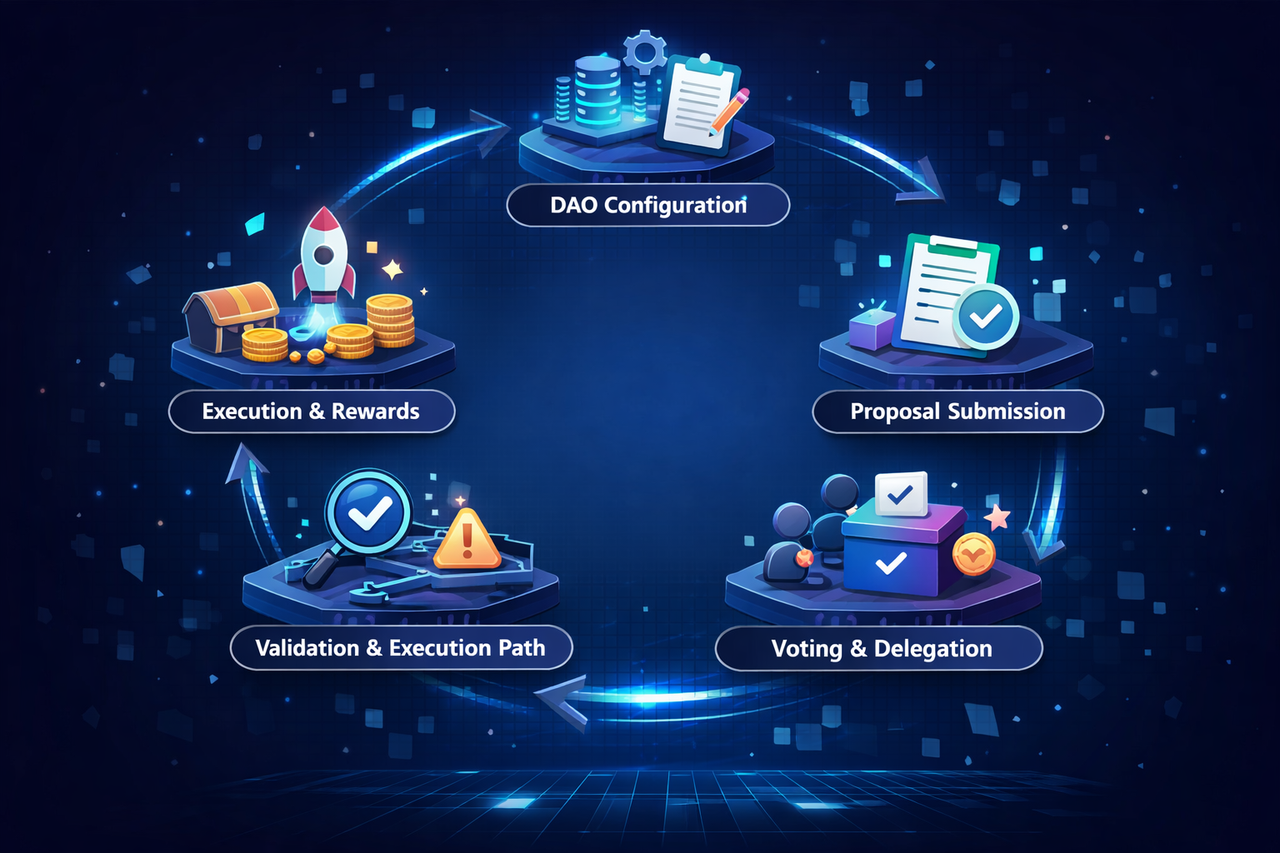
This lifecycle transforms governance into a continuous coordination system rather than a one-time voting event. Each stage is connected, ensuring that proposals move through a predictable path from submission to execution, with incentives reinforcing participation along the way.
By structuring governance as a modular and repeatable process, DeXe enables DAOs to operate with greater clarity, accountability, and automation. Decisions are not only made collectively but are also validated, executed, and reflected in the system state through a unified on-chain workflow.
How DeXe distributes and aligns incentives across participants
In DeXe, incentives are embedded directly into the governance process to encourage meaningful participation and long-term alignment.
| Incentive Type |
Description |
Purpose |
Effect on Governance System |
| Proposal Rewards |
Rewards granted to participants who submit proposals that are approved |
Encourage high-quality and relevant ideas |
Reduces spam and improves overall governance quality |
| Voting Rewards |
Incentives for participants who vote on proposals that are successfully accepted |
Promote active and meaningful participation |
Increases engagement and strengthens decision legitimacy |
| Execution Rewards |
Rewards for executing approved proposals and completing governance actions |
Ensure operational follow-through |
Improves reliability and ensures proposals are implemented |
| Delegation Rewards |
Shared rewards between delegators and experts based on delegated voting power |
Support expertise-driven governance |
Aligns incentives and enhances decision quality through delegation |
This model ties rewards to successful governance outcomes rather than passive activity, ensuring that participation reflects meaningful contribution. It also incorporates delegation-based participation, allowing expertise-driven decision-making while enabling treasury involvement to strengthen overall coordination.
This approach shifts governance from passive token holding toward active contribution, where influence is linked to participation and effectiveness.
DeXe aligns incentives by rewarding accepted proposals, meaningful voting, execution actions, and delegation, linking governance influence to active participation rather than passive ownership.
The role of DEXE and governance mechanisms within DeXe
DEXE functions as the primary governance token within the DeXe ecosystem, acting as a coordination layer that enables participation in decision-making, resource allocation, and incentive distribution. Rather than serving only as a voting asset, DEXE connects governance actions with broader system outcomes, allowing participants to influence both policy direction and treasury management through collective decision-making.
Its utility extends across multiple governance functions, including proposal voting, contributor incentives, treasury control, and delegation. Through delegation, DEXE enables participants to transfer voting power to more active or knowledgeable members, supporting a governance model that incorporates expertise rather than relying solely on token ownership.
Beyond standard token-based voting, DeXe introduces additional governance mechanisms that expand how influence is structured and exercised. These include delegated governance models, nonlinear voting logic that can adjust influence dynamics, validator-based checks for additional verification, and support for multiple governance assets such as ERC20 tokens, NFTs, or hybrid systems.
As a result, governance within DeXe is not determined purely by token holdings but by a combination of configurable rules, participation patterns, delegation structures, and system design. DEXE operates within this broader framework as a coordination tool that links governance participation with execution and treasury outcomes, enabling more flexible and structured decentralized decision-making.
The differences between DeXe and traditional DAO or governance models
DeXe differs from conventional DAO frameworks by focusing on governance as a complete system rather than a standalone voting mechanism.
| Aspect |
DeXe Approach |
Traditional DAO Model |
Detailed Explanation |
| Structure |
Integrated governance system combining voting, treasury, delegation, and execution |
Fragmented tools with separate systems for voting, treasury, and execution |
DeXe unifies governance functions into a single architecture, reducing coordination gaps, whereas traditional DAOs often rely on multiple disconnected tools that require manual integration |
| Proposal Logic |
Flexible and customizable proposal frameworks with multiple templates and rules |
Fixed or limited proposal formats with standard voting flows |
DeXe allows different proposal types, configurable parameters, and adaptable workflows, enabling DAOs to tailor governance to specific needs, unlike rigid traditional systems |
| Participation Model |
Delegation and expertise-driven governance with nonlinear influence mechanisms |
Token-weighted voting where influence is proportional to holdings |
DeXe supports delegation and recognizes expertise, allowing more informed decision-making, while traditional models often favor large token holders |
| Incentive Design |
Built-in reward systems for proposals, voting, execution, and delegation |
Minimal or informal incentives, often voluntary participation |
DeXe formalizes incentives to encourage active and meaningful engagement, whereas traditional DAOs may struggle with low participation due to lack of rewards |
| Governance Scope |
Governance directly linked to treasury management and execution outcomes |
Governance often separated from execution, requiring additional steps |
In DeXe, decisions automatically impact treasury and operations through smart contracts, while traditional DAOs may rely on off-chain or manual execution processes |
This comparison highlights that DeXe functions as a governance operating system where decision-making, incentives, and execution are integrated, enabling more adaptive, efficient, and structured decentralized coordination.
DeXe differs by integrating governance, incentives, delegation, and execution into a unified system rather than treating voting as an isolated function.
The advantages and potential issues of DeXe’s operating model
DeXe’s governance architecture is designed to provide a more structured and flexible coordination system, but this flexibility also introduces certain complexities. Its operating model reflects a balance between advanced functionality and the challenges of implementation.
Advantages
-
High configurability DeXe allows DAOs to customize governance parameters such as quorum, voting duration, proposal types, and execution rules. This flexibility enables organizations to adapt governance structures to different use cases and stages of growth.
-
Integrated coordination system Governance, treasury management, and execution are interconnected within a single framework. This reduces fragmentation and ensures that decisions are directly linked to operational outcomes.
-
Delegation and expertise-driven participation Delegation mechanisms allow participants to transfer voting power to more knowledgeable or active members, supporting more informed and efficient decision-making.
-
Automation and transparency Smart contract-based execution ensures that approved proposals are carried out automatically, while on-chain processes provide visibility into governance actions and resource allocation.
Potential limitations
-
Governance design complexity The flexibility of DeXe requires careful configuration. Poorly designed parameters can lead to inefficiencies, governance deadlock, or unintended incentives.
-
Smart contract dependency As governance and execution rely heavily on smart contracts, any vulnerabilities or errors in code can impact both decision-making and treasury operations.
-
Delegation concentration risk While delegation improves efficiency, it may also concentrate influence among a smaller group of participants if governance becomes overly reliant on a few experts.
-
Dependence on active participation The effectiveness of the system depends on consistent and informed participation. Low engagement can weaken governance outcomes and reduce system resilience.
Overall, DeXe’s model represents a trade-off between flexibility and complexity. It enables advanced and customizable governance structures, but its effectiveness ultimately depends on how well each DAO designs, configures, and actively maintains its governance system.
Summary
DeXe Protocol operates as a modular governance architecture that integrates DAO configuration, proposal management, voting, delegation, execution, and incentives into a unified system. This integration allows decentralized organizations to move beyond isolated governance actions and instead function through coordinated, system-driven processes.
By structuring governance as a programmable and continuous workflow, DeXe enables decisions to progress seamlessly from proposal to execution while maintaining alignment with incentives and resource management. This approach improves coordination efficiency and reduces reliance on manual intervention.
DeXe reflects a broader shift from simple voting mechanisms toward comprehensive governance frameworks that define how decentralized organizations operate, adapt, and scale over time.
At its core, DeXe combines governance rules, participation models, and execution logic into a single architecture, supporting structured, transparent, and scalable decentralized coordination.
FAQs
What does DeXe Protocol mainly do?
It provides infrastructure for creating and managing DAOs, including governance, voting, delegation, treasury management, and reward distribution.
Does DeXe only support token voting?
No, it supports multiple governance models, including token-based, NFT-based, and delegated systems.
What is the role of DEXE?
DEXE is used for governance participation, incentive alignment, and treasury coordination within the ecosystem.
Does DeXe reward governance participation?
Yes, participants can receive rewards for proposal creation, voting, execution, and delegation.
Why is DeXe different from other DAO frameworks?
Because it integrates governance, incentives, delegation, and execution into a single system rather than treating them as separate functions.