


Futures
Access hundreds of perpetual contracts
TradFi
Gold
One platform for global traditional assets
Options
Hot
Trade European-style vanilla options
Unified Account
Maximize your capital efficiency
Demo Trading
Futures Kickoff
Get prepared for your futures trading
Futures Events
Join events to earn rewards
Demo Trading
Use virtual funds to experience risk-free trading
Launch
CandyDrop
Collect candies to earn airdrops
Launchpool
Quick staking, earn potential new tokens
HODLer Airdrop
Hold GT and get massive airdrops for free
Launchpad
Be early to the next big token project
Alpha Points
Trade on-chain assets and earn airdrops
Futures Points
Earn futures points and claim airdrop rewards







"Green Fuel" Subsector Revealed: These Concept Stocks Are Gaining Attention from Institutions
In 2026, the government work report includes “green fuels” as a new growth point.
“Green fuels” included in the government work report for the first time
The 2026 government work report states, “Vigorously develop a green low-carbon economy. Improve policies to promote green low-carbon development, implement quality improvement, cost reduction, and carbon reduction actions in key industries, and deepen the construction of zero-carbon parks and factories. Establish a national low-carbon transition fund to cultivate new growth points such as hydrogen energy and green fuels.”
This is the first time “green fuels” have been mentioned in the government work report and positioned as a “new growth point.” Green development is the foundation of high-quality growth. The December Central Economic Work Conference designated “promoting comprehensive green transformation” as one of the eight key tasks for 2026.
Industry insiders believe that developing green fuels is an essential response to the “dual carbon” strategy and achieving green low-carbon development. The “Outline of the 15th Five-Year Plan for National Economic and Social Development of the People’s Republic of China (Draft)” proposes five indicators related to green low-carbon efforts, including a 17% reduction in carbon dioxide emissions per unit of GDP and continued promotion of green low-carbon transformation in key areas.
Meanwhile, the 2026 government work report sets an expected goal of approximately 3.8% reduction in carbon dioxide emissions per unit of GDP this year.
In fact, from 2021 to 2025, the government work report has consecutively outlined green low-carbon initiatives for five years. The 2022 report emphasized “promoting green low-carbon development”; 2023 focused on “promoting a green transformation of development modes”; 2024 called for “vigorously developing a green low-carbon economy”; and 2025 aimed to “accelerate the development of a green low-carbon economy.”
China Galaxy Securities notes that during the “14th Five-Year Plan” period, China has largely achieved its goal of reducing energy consumption per unit of GDP.
Key to industry decarbonization
According to a research report from Guotou Securities, green fuels mainly include green hydrogen, green methanol, green ammonia, sustainable aviation fuel (SAF), and Power-to-Liquid (PtL) fuels. Unlike traditional fossil fuels, green fuels are characterized by low carbon and sustainability, and can be directly applied in heavy industries, ocean shipping, long-distance freight transportation, and other sectors difficult to electrify.
The China Petroleum & Chemical Corporation’s Economic and Technical Research Institute released the “2025 Domestic and International Oil & Gas Industry Development Report,” predicting that during the 15th Five-Year Plan, China’s dependence on foreign oil will remain around 70%. As energy structure transformation deepens, new energy sources are expected to replace traditional fossil fuels trend-wise. Green fuels have become a key tool in industry decarbonization, with increasing importance frequently highlighted in top-level design and major meetings.
In October 2025, the National Development and Reform Commission and the National Energy Administration issued the “Guiding Opinions on Promoting New Energy Consumption and Regulation,” which proposed coordinating the layout of green hydrogen, ammonia, alcohol, and other green fuel production, storage, transportation, and utilization industries to create “flexible loads.”
Recently, the National Energy Administration held a special symposium on green fuel industry development. The meeting pointed out that developing the green fuel industry helps replace oil, ensure energy security, reduce carbon emissions, promote green development, facilitate the utilization and absorption of new energy non-electrical forms, and is an important direction for the development of new productive forces in the energy sector.
Demand side expected to grow rapidly
Guotou Securities states that the green fuel industry in China already has a certain foundation, and in the future, green fuels will not only serve as “supplementary energy” but also aim to replace and optimize the structure of oil consumption. The commercialization process is expected to accelerate further with more specific policy support.
In the maritime sector, green methanol is one of the important alternative fuels for decarbonization. Founder Securities notes that shipping demand is steadily increasing, and reserves of green alcohol are gradually rising. According to data released by consulting firm GENA in January, global green methanol capacity is expected to reach 47.1 million tons per year by 2031, with bio-methanol accounting for 23.5 million tons and electro-methanol for 23.6 million tons. From 2025 to 2031, the compound annual growth rate of green methanol capacity exceeds 90%, with China’s renewable methanol projects accounting for 59% of global capacity.
Regarding hydrogen energy, China’s hydrogen industry has become the largest in the world. Data shows that in 2025, China’s hydrogen production will exceed 37 million tons, with green hydrogen capacity surpassing 250,000 tons per year. Core equipment such as electrolyzers has advanced to the forefront globally. Market research firm Markets and Markets reports that the global green hydrogen market is expected to explode, growing from $2.79 billion in 2025 to nearly $75 billion in 2032, with a compound annual growth rate of 60%, demonstrating strong development potential.
For sustainable aviation fuel, Guotou Securities points out that several countries and regions, including the EU, UK, and Canada, have set mandatory blending ratios for SAF, with the EU and UK implementing these requirements as of 2025 with firm commitment.
Green fuel concept stocks emerge
In the A-share market, there are 85 stocks involved in green fuels such as hydrogen, methanol, ammonia, and sustainable aviation fuel. Among them, hydrogen industry chain companies are the most numerous and have the most complete industry chain.
As of March 6, these 85 stocks have an average increase of over 22% this year, with 60 stocks gaining more than 10%. Stocks like Jinnuo Chemical, Dongfang Electric, Xinjin Power, and Weichai Power have each increased over 50% since the start of the year. Jinnuo Chemical produces 200,000 tons of methanol annually; Dongfang Electric’s related production lines in Panzhihua and Dongfang Hydrogen Energy Industrial Park are progressing normally.
Institutional attention is high; among these stocks, 22 have been visited by institutions this year, with 16 receiving visits from 15 or more institutions. HanZhong Precision Machinery, Zhuoyue New Energy, and Jiahua Energy have each been visited by over 50 institutions.
HanZhong Precision Machinery has been visited by 76 institutions this year. The company successfully developed air compressors for fuel cells in 2022 and has delivered prototypes for testing to downstream clients, currently engaged in verification and product series development.
Zhuoyue New Energy has been visited by over 60 institutions this year. The company is involved in the sustainable aviation fuel concept, with its first-phase biobased diesel project completed and accepted on February 12, 2026. Certification work for ISCCCORSIA, airworthiness, and SAF export white list is progressing smoothly.
Dahua Technology has gained over 18% this year. Recently, the company announced signing a contract with Inner Mongolia Recycled Green Hydrogen Energy Co., Ltd. for the EPC of an 800,000-ton green ammonia project, with a contract value of approximately 2.026 billion yuan.
9 profitable stocks are heavily researched by institutions
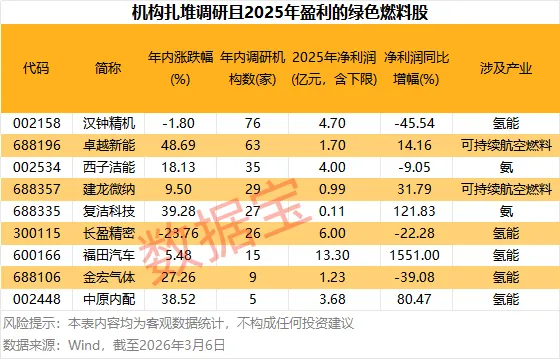
Further analysis shows that among the 85 stocks, nine have been visited by five or more institutions this year and are expected to be profitable in 2025 (including lower bounds of forecasts).
These nine stocks have an average increase of nearly 18% this year. Zhuoyue New Energy, Fuje Technology, and Zhongyuan Neijiang have each increased over 38%. Longying Precision and HanZhong Precision have experienced slight declines. Seven stocks, including Xizi Clean Energy, Jianlong Micro-Nano, and Fuje Technology, have been visited by 15 or more institutions.
In terms of profitability, the top net profits in 2025 are expected from Foton Motor, Longying Precision, HanZhong Precision, and Xizi Clean Energy.
Foton Motor’s net profit in 2025 is projected at 1.33 billion yuan, up 1551%. The company has planned and implemented integrated technology reserves and industrial layout for hydrogen fuel cell heavy trucks, including core components like fuel cell engines, hydrogen storage systems, control systems, and electric drive axles.
Longying Precision is expected to achieve a net profit of 600 million yuan in 2025. The company has mastered key technologies for hydrogen fuel cell metal plates.
Xizi Clean Energy’s net profit (lower bound) in 2025 is estimated at 400 million yuan, slightly down from the previous year. The company invested in Zhen Tai Energy in 2021 to develop fuel cells and is involved in the integrated wind, solar, hydrogen, and ammonia production model, supplying equipment such as molten salt energy storage devices, waste heat boilers, and heat exchangers.
( )
)
(Article source: Data Treasure)