
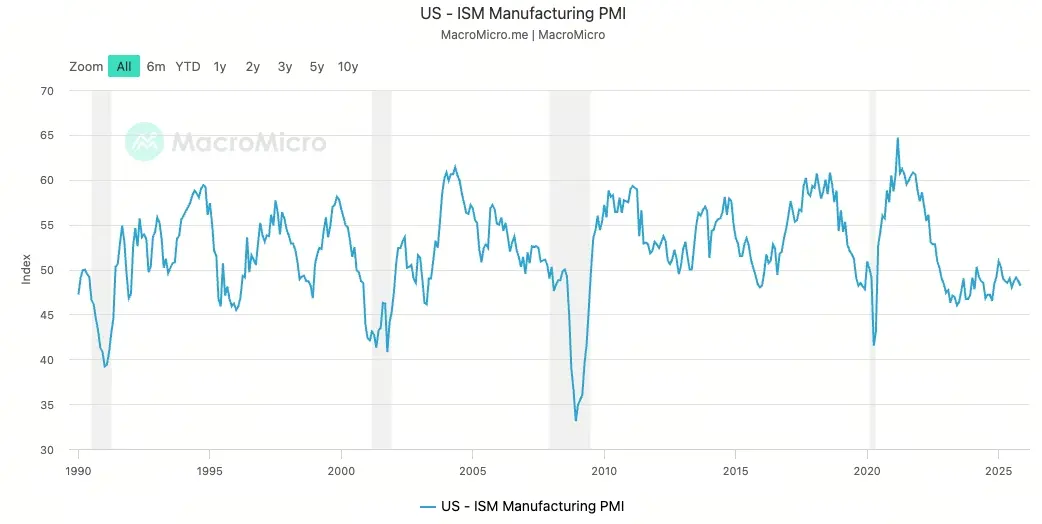
2025 marks the first year since the Bitcoin halving that the annual close has declined, breaking the traditional 4-year cycle rule. The core reason is that the US PMI indicator continues to hover in the neutral 46-50 range. Based on the cyclical decline pattern, 2026 may face a 60% to 65% retracement, with a target price of $42,000 to $48,000. The decisive factor is whether PMI can rebound above 51 in the second half of the year.
The Historical Significance of Bitcoin’s First Year-End Decline Post-Halving
2025 is the first time in Bitcoin’s history that the year ended with a decline following a halving. From a purely closing perspective, this is indeed a perplexing occurrence. Historical cycles show that Bitcoin tends to perform most strongly in the year after halving: from 2015 to 2017, it surged about 12,000%, followed by an 85% maximum decline in the 2018 bear market; from 2019 to 2021, it gained approximately 2,100%, then experienced a 77% maximum decline in 2022.
Following the cyclical decline pattern, Bitcoin’s rise from 2023 to 2025 is about 720%. Therefore, 2026 might usher in a new bear market, with a maximum decline around 60% to 65%, corresponding to prices near $42,000 to $48,000. Since October last year, Bitcoin has already experienced about a 36% retracement, which seems to reinforce some people’s confidence in the 4-year cycle rule.
But will history truly repeat itself perfectly? The peculiarity of 2025 lies in the fact that it neither fully negates the cycle rule nor completely breaks traditional patterns. Many previously popular on-chain indicators seem to have temporarily lost their guidance in this cycle. Bitcoin is currently at the intersection of “patterns and breakthroughs,” making it dangerous to simply apply historical experience.
PMI and LEI Dual Indicators Reveal the Ultimate Answer
(Source: Macro Micro)
The core determinant of market trends is not time-based regularity but human nature. Markets are composed of “people,” who exhibit greed, fear, and expectations. All these factors are reflected in price behavior and are anticipated through market reactions. Bitcoin’s price cannot change only after everyone is ready; it is always priced in advance—an anti-human nature process.
What determines people’s behavior? Credit expansion often leads to increased risk appetite, which in turn promotes rising asset prices, and vice versa, forming the oscillating pattern of economic (business) cycles. Since Bitcoin gained speculative/investment attributes, it is no longer an isolated niche market of tech enthusiasts but is tied to economic cycle changes. When credit expands and risk appetite rises, capital flows into volatile but high-return assets; when the economy contracts and liquidity tightens, Bitcoin faces greater price volatility due to regulatory uncertainty and higher volatility.
PMI (Manufacturing Purchasing Managers’ Index) mainly reflects the overall health of the US manufacturing sector and is regarded as a leading indicator of economic growth and inflation. Typically, a PMI above 50 indicates expansion, while below 50 indicates contraction. LEI (Leading Economic Indicators) are used to forecast the US economic trend 3 to 6 months ahead. Comparing these two indicators with Bitcoin’s trend reveals a high positive correlation.
The Three-Stage Relationship Between PMI and Bitcoin
Expansion Stage (2023-2024 Q1): PMI is rising, risk appetite is gradually recovering, and Bitcoin prices are slowly climbing, entering the first upward phase of this cycle. This is a typical expansion phase.
Contraction Stage (Starting March 2024): PMI begins to decline again, indicating economic weakening, risk appetite decreases, and Bitcoin prices undergo a clear correction. This is a typical contraction phase.
Re-expansion Stage (Second half of 2024 to early 2025): PMI enters a new expansion, market expectations for economic development improve, risk appetite increases again, and Bitcoin experiences a new significant rally, entering the second expansion phase.
Starting in 2025, an interesting change occurs. Market expectations for the economy become chaotic. PMI from Q2 to Q4 2025 remains in the neutral zone (no clear expansion or contraction trend). Correspondingly, Bitcoin’s price trend in 2025 also becomes tangled, stuck in wide-range oscillation. To sum up 2025 in one sentence: PMI shows no clear direction, and BTC shows no obvious trend.
Two Scenarios for 2026
Based on PMI indicators and global economic variables, Bitcoin in 2026 may follow two very different scenarios. In the pessimistic scenario, ongoing tariffs and regional frictions create persistent uncertainty. In the first half of this year, PMI may continue to fluctuate mildly or decline slightly (remaining between 49-50). If PMI stays below 50, Bitcoin could continue its correction, testing the support zone of $42,000 to $48,000, which would validate the effectiveness of the traditional 4-year cycle.
In the optimistic scenario, in the second half of this year, with changes in Federal Reserve monetary policy and phased improvements in global situations, PMI might stabilize or slightly rebound (around 51-52). If PMI breaks above 50 again and accelerates upward, it would confirm the start of a new expansion cycle. Bitcoin could regain upward momentum in Q3, challenging targets of $150,000 or even higher, meaning the 4-year cycle rule has been thoroughly rewritten by new market structures.
The key observation window is in Q2. PMI data from April to June will determine the year’s direction. If PMI remains below 50 during this period, the probability of the pessimistic scenario increases significantly; if it breaks above 51 and stabilizes, the optimistic scenario will dominate the narrative. For investors, the current task is not to predict the outcome but to manage positions: if you believe the cycle rule is still valid, keep sufficient cash flow for phased investments; if you think the rule has been broken, your current holdings should be able to withstand larger volatility or opportunities.
Disclaimer: The information on this page may come from third parties and does not represent the views or opinions of Gate. The content displayed on this page is for reference only and does not constitute any financial, investment, or legal advice. Gate does not guarantee the accuracy or completeness of the information and shall not be liable for any losses arising from the use of this information. Virtual asset investments carry high risks and are subject to significant price volatility. You may lose all of your invested principal. Please fully understand the relevant risks and make prudent decisions based on your own financial situation and risk tolerance. For details, please refer to
Disclaimer.


